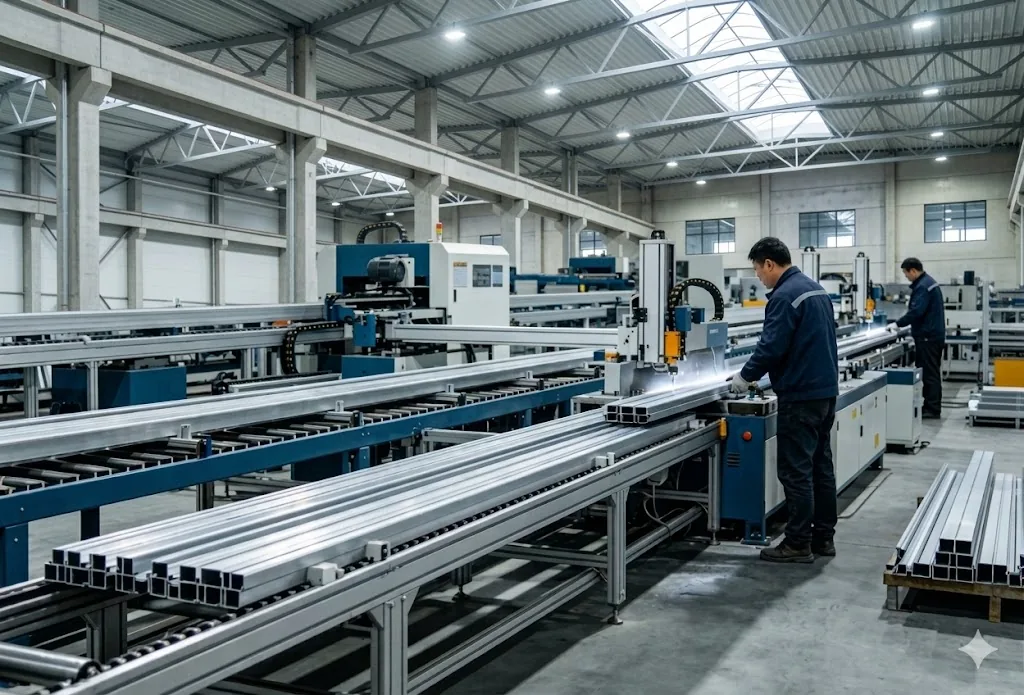
Sectional sliding gate for curved and tight entrances
Hinged aluminum panels follow a curved track and park along the side wall.
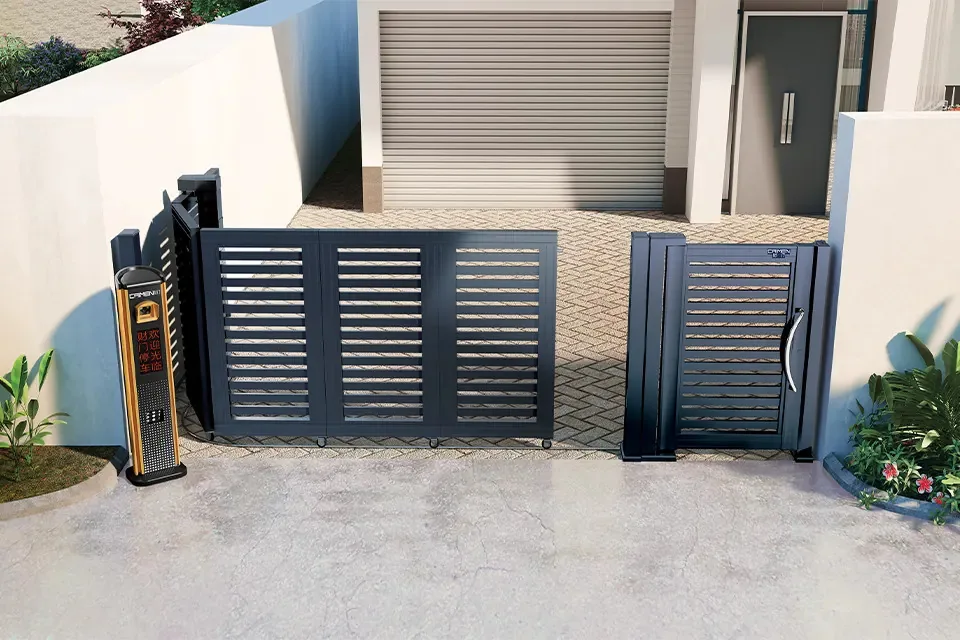
For entrances where nothing else fits
The curved track lets the gate turn the corner and stack beside the opening, so it suits garages, community entrances and plots with obstacles beside the gate. Panels can be solid for privacy or open for ventilation.
Specifications
Values from CAIMEN product documentation. Drawings for your project confirm final sizes.
| Name | Main Frame | Inner Frame | Stand Tube |
|---|---|---|---|
| Material | 6005-T5 | 6063-T6 | 6063-T6 |
| Size mm | 95*63* Thickness 3.0 | 59*27* Thickness1.8 | 47*37*1.3 |
Product views
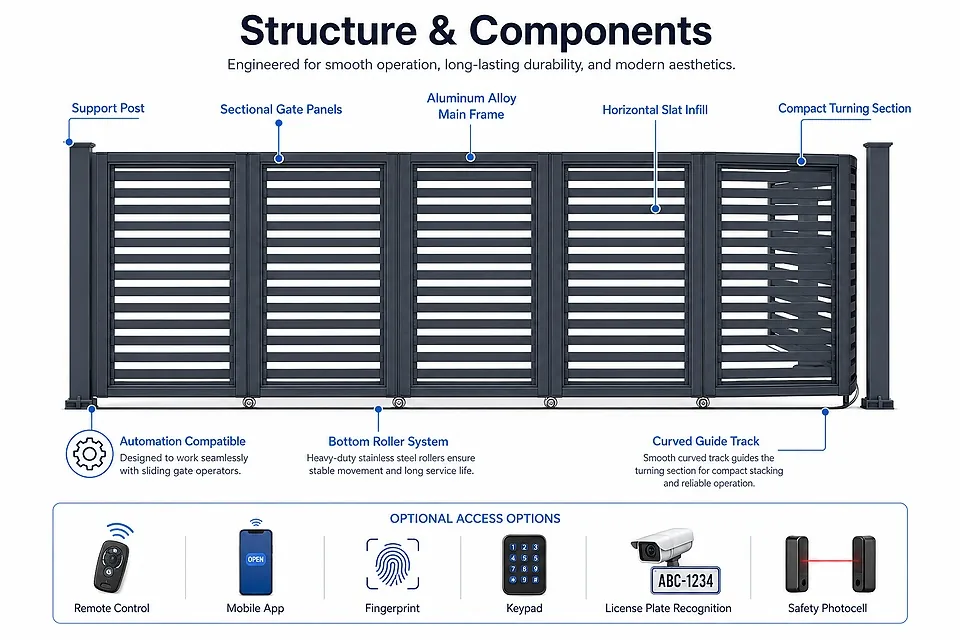
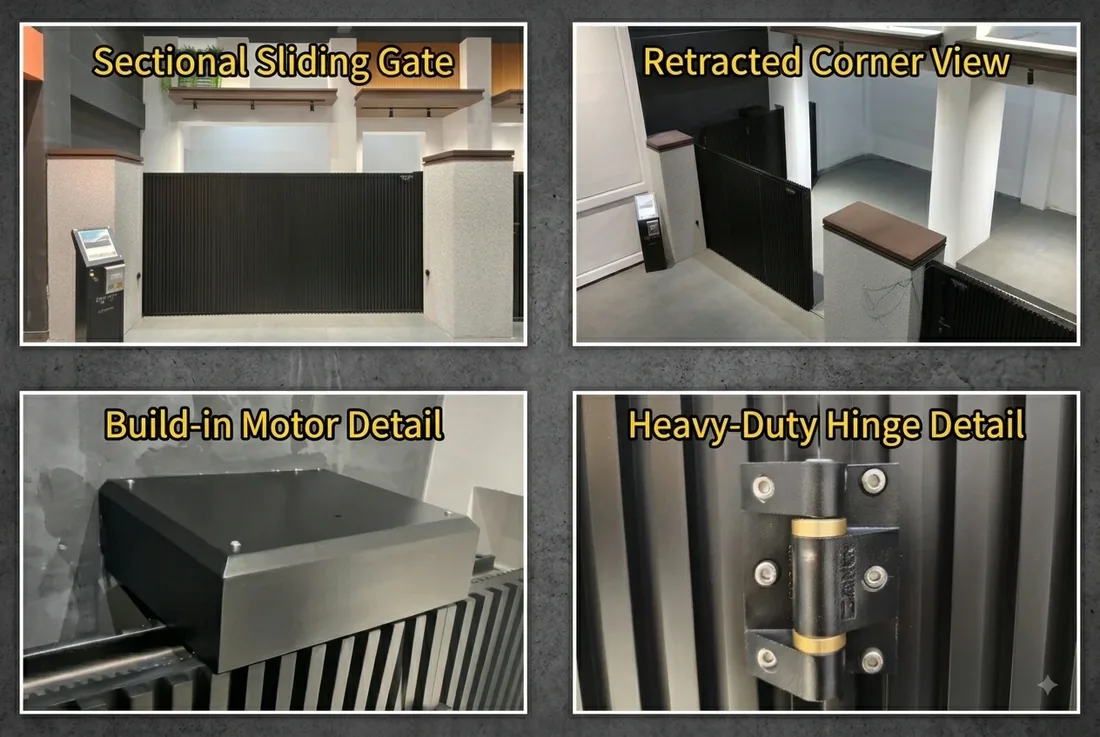
Overview
The CAIMEN Turning Sectional Sliding Gate is for the entrance that's already ruled out everything else. Its panels are hinged. They run on a curved track, round the corner, then lie flat against your side wall. No swing arc out front, no straight run-back along the fence line, and no counterweight tail sticking out behind. The panels park in their own strip along the side wall. CAIMEN is a Shenzhen-based manufacturer of gates and access control equipment, founded in 2013, supplying sectional sliding gates to distributors, installers and project buyers worldwide.
Say your boundary wall bends inward a metre past the post. A conventional straight sliding gate still needs a straight wall to slide along, so it's out. This gate just follows the line you've got.
It sits with our other automatic gates on the products page. Like the rest of the range, it's drawn to your site before anything gets cut.
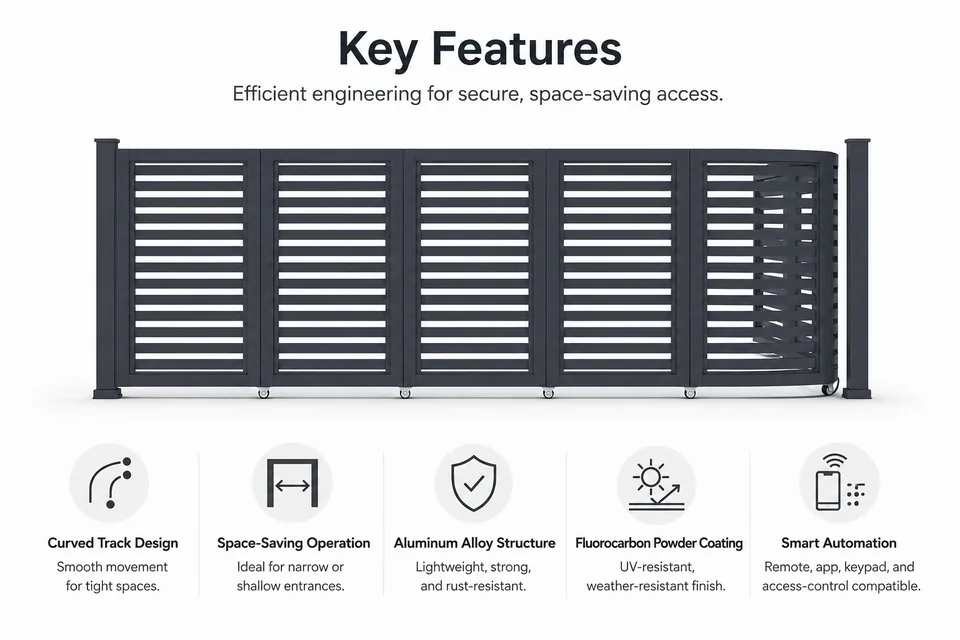
Key features
A track that bends with the site
We lay the track to a predesignated curve. Open the gate and each panel tracks that curve, sliding sideways against the wall. Posts, planters, whatever sits beside the opening: the leaf stays clear of them.
No depth needed front or back
Swing gates eat the driveway. This one doesn't. The whole gate body moves inside its own allocated strip next to the opening, so the road outside stays open and so does the footpath inside. Hence garages, tight community entrances, shallow plots.
Aluminium sections, specified profiles
Main frame? A 6005-T5 extrusion, 95 x 63 mm, with a 3.0 mm wall. Inside the panel you get 6063-T6 inner frames and stand tubes. It's the hinged sections that let a rigid gate get round a bend at all.
Motor drive with the controls you already use
Remote, keypad password, fingerprint, phone app or a smart home system all work. Good motors and pulleys keep it quiet, which your neighbours will notice when someone comes home late. Want lighting and cameras too? Add them, including license plate recognition, and regular vehicles get in without anybody touching a button.
Looks matched to the building
There are plenty of colour and texture combinations. Hollow, see-through infill lets air through and keeps the street in view. If privacy matters more to you, go for the closer fence-style panels instead. Our coatings page covers the finish systems.
Where it fits
The opening itself is usually fine. It's the space around it that isn't. Typical spots:
- a villa where the boundary wall curves or steps back near the gate
- commercial complexes and driveways with columns, signage or planting right beside the entrance
- high-end garages and courtyards, almost zero depth behind the gate line
- industrial zones with curved or narrow entrances
- any site without back-room for a straight slider or swing leaf
Got a long, straight wall beside the opening? Then a cantilever sliding gate is the simpler choice for heavy-duty, high-traffic openings. Short wall, wide opening: look at a telescopic sliding gate. We'll be honest. The turning gate earns its keep only when the wall bends or something permanent is in the way.
How to specify it
Every curved-track gate is drawn for one site. So the quote is only as good as your survey. Here's what we need:
- clear opening width, plus the gate height you'd like
- a plan sketch of the wall it'll park against (bend radius or angle, and how far that bend is from the post)
- photos from inside and outside, showing whatever's next to the opening: trees, meter boxes, drains, columns
- how you'll open it, whether that's remote, keypad, fingerprint, app, smart home or plate recognition
- hollow or fence-panel infill, and the colour
| Your entrance | Usually the better fit |
|---|---|
| Side wall bends or has an obstacle near the post | Turning sectional sliding gate |
| Long straight wall, wide or heavy-duty opening | Cantilever sliding gate |
| Short straight wall, wide opening | Telescopic sliding gate |
| Little side wall, wide opening, room for folded leaves to swing inside | Bi-folding gate |
CAD drawings and renderings come first. Nothing goes into production until you approve them, and after that it typically takes 15 to 20 days. Non-standard panels? See custom aluminum gates. Send everything through the contact page or email [email protected].
Don't skip safety. US buyers will expect automatic gate operators to meet UL 325, while ASTM F2200 covers gate construction. DASMA's gate safety guide says any gap over 2 1/4 in (57 mm) between a slide gate and a fixed object must be protected, for example with edge sensors where the gap creates a draw-in zone. A curved run passes more fixed objects than a straight one does. Have your installer map those points before the track goes down.
Sources
Product figures come from CAIMEN product documentation.
CAIMEN Turning Sectional Sliding Gate questions
What is a turning sectional sliding gate?
Picture an automatic gate built from hinged aluminium panels on a curved track. When it opens, the panels follow the curve and park along your side wall. It's meant for entrances where the wall bends or something sits beside the opening, and where you've got no room for a swing arc or a straight run-back.
How is it different from a cantilever sliding gate?
A cantilever gate is one rigid leaf. It slides in a straight line, so you need a long, clear wall beside the opening. Ours is split into hinged panels that bend round a corner. Straight wall and heavy use? Pick cantilever. Curved wall or an obstacle, go with the turning gate.
What material is the frame made of?
Aluminium throughout. The main frame is 6005-T5 at 95 x 63 mm, with a 3.0 mm wall. Inner frames are 6063-T6 at 59 x 27 x 1.8 mm, and the stand tubes are 6063-T6 too, at 47 x 37 x 1.3 mm.
Can it connect to my access control system?
Yes. You can run the motor drive from a remote, keypad password, fingerprint reader, mobile app or smart home system. Lighting is optional. So are cameras with license plate recognition, which let known vehicles in automatically.
How long does production take?
You'll get CAD drawings and renderings from us first. Once you've approved them, production typically takes 15 to 20 days. Honestly, accurate measurements and clear photos are what get drawings signed off fastest.
Quote for Sectional sliding gate
Send the size, quantity and destination port. We reply within 24 hours.
Or email [email protected]