Pedestrian access gates: swing barrier turnstiles
Swing barrier gates and terminals for offices, stations and residential lobbies.
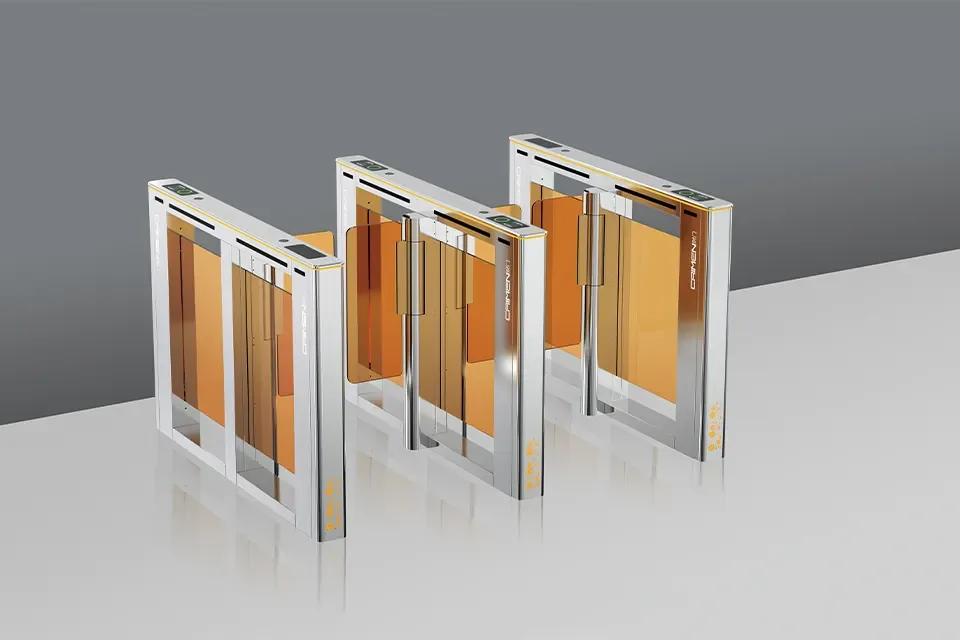
Fast, safe passage
The ST001 runs on brushless DC drives at 30 to 50 people per minute, with infrared tracking and voice prompts. Wings swing freely in a power failure for fire evacuation. Card, QR code, fingerprint and face recognition modules are available.
Specifications
Values from CAIMEN product documentation. Drawings for your project confirm final sizes.
| Model | Pedestrian gate ST001 |
|---|---|
| Size | L1400*W120*H980mm |
| Input Voltage | AC220V±10%, 50Hz ~ 60Hz |
| Opening Method | RS485/RS232/IO |
| Drive Motor | Brushless DC motor (24 ~ 36VDC) |
| Work Environment | -30~75℃ |
| Operating Humidity | 0~90% (no condensation) |
| Gate Working Speed | 30 ~ 50 people/minute (memory mode can be turned on) |
| Service Life | Continuous opening and closing more than 5 million times |
| Swing Door Material | Transparent acrylic |
| Case Material | The shell is made of 304 stainless steel, with brushed surface |
| Configuration | 2 single-movement cabinet/2 swing doors/1 pair of master slave control boards/2 sets of brushless drive movements/8 pairs of infrared beams/1 set of power supply |
| Passing Time | Passing time after swiping the card: 10 seconds (if no one passes within 10 seconds: the gate will close automatically, and the time can be adjusted as needed) |
| Optional | Access control system/card swipe module/QR code module/face recognition device/embedded face recognition module |
| Applicable Places | Indoor unit: can be used in: airports, subways, libraries, office buildings, theaters, office buildings, scenic spots, stations, leisure and entertainment venues, etc. |
Product views
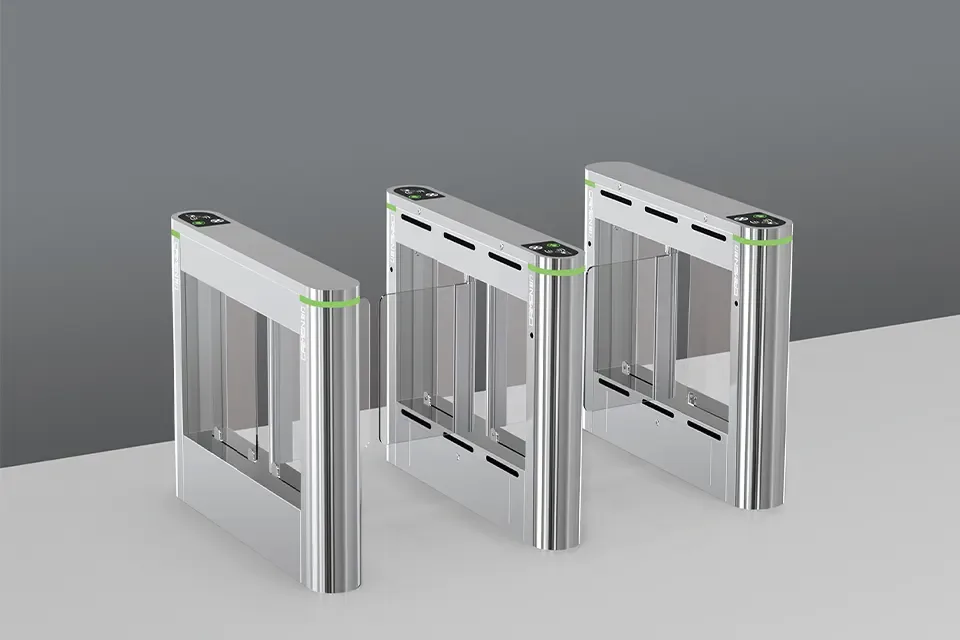
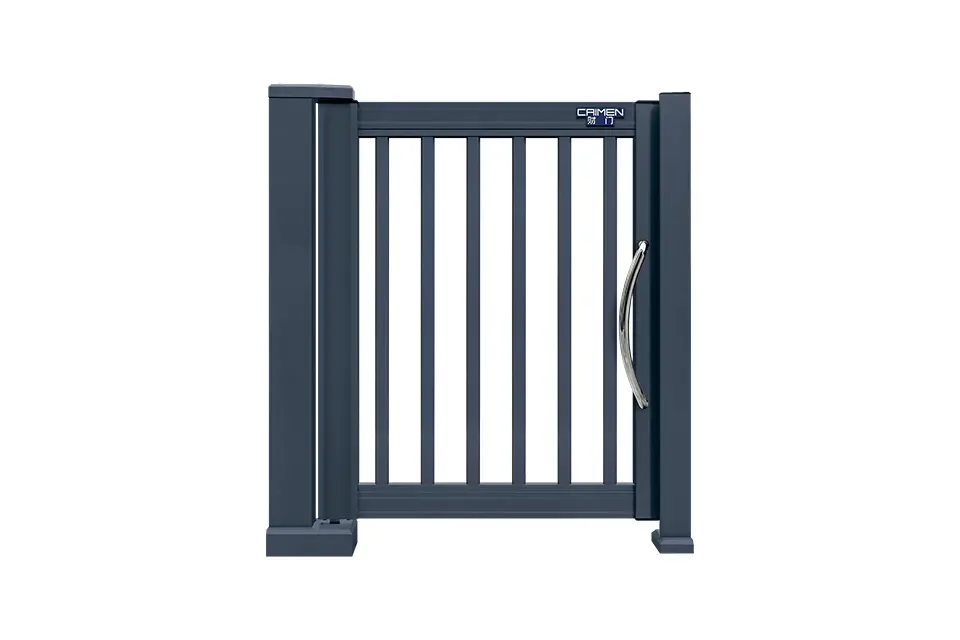
Overview
The CAIMEN Pedestrian Access Gate is a swing-barrier lane for lobbies, campuses and transit halls. It comes in two cabinets, ST001 and ST002, and can be paired with our 7-inch binocular face recognition terminal (ST001 lists face recognition, card, QR and fingerprint modules as options). Someone badges in or looks at the camera. The wing opens. Infrared beams track the person, then it closes. CAIMEN is a Shenzhen-based manufacturer of gates and access control equipment, founded in 2013, supplying pedestrian access gates to distributors, installers and project buyers worldwide.
Why not a tripod arm? A released swing wing leaves the lane open. Strollers roll through. So do suitcases and delivery carts, and nobody has to climb over a bar.
Key features
Two cabinets, two jobs
Of the two, ST001 is slimmer. It measures L1400 x W120 x H980 mm, with transparent acrylic wings in a brushed 304 stainless steel shell. Turn memory mode on and you'll get 30 to 50 people per minute, and it's rated for more than 5 million open and close cycles. ST002 is shorter but wider at L1200 x W180 x H1020 mm. A steel frame sits inside a 1.0 mm SUS304 shell with a 1.2 mm top cover. It tops out at 30 people per minute. Cycle life, though? Past 8 million. So pick ST001 for throughput and ST002 for long, heavy service.
Infrared tracking in the lane
You get 8 pairs of infrared beams on ST001 and 4 to 6 pairs on ST002, giving safe infrared tracking of people in the lane. ST001 adds a voice prompt that tells you when to walk.
Memory mode for the 8:55 rush
Picture forty staff stepping off one shuttle bus. Memory mode stores several valid swipes in a row, so the lane stays open between people.
Free swing when power fails
Cut the power to ST001 and its wings go slack. People just push through. That's its fire evacuation escape design, and your fire officer will ask about it first.
Brushless drive, standard interfaces
Each model runs a brushless DC motor on 24 to 36 VDC. It opens on an RS485, RS232 or IO signal. ST002 goes a step further with Modbus over RS232 and 2 kV lightning protection. If nobody walks through within 10 seconds, the gate closes again, and you can change that window.
Face terminal on top
The 7-inch binocular terminal pairs an HD color camera with an infrared one. Liveness detection runs offline. The library holds 10,000 faces, and recognition takes 300 ms or less for someone standing 0.5 to 1.5 m away, with claimed accuracy of at least 99%. Output? Wiegand 26/34/66 or a relay.
Where it fits
ST001 is listed as an indoor unit, so keep it under a roof: office towers, subway concourses, libraries, theaters, airports, scenic-spot ticket halls. ST002 fits those same spaces. It also suits sites that value cycle life over peak flow: government buildings, hospitals, schools and stadiums.
- Office lobbies, where the face terminal doubles as an attendance recorder with exportable reports
- Residential community entrances, with vehicles handled by our barrier gates and the layouts on our gated communities page
- Campus buildings, since the terminal supports K12 children's face recognition (see schools and campuses)
How to specify it
Start with the people count. The finish can wait. Count heads in your busiest five minutes, then divide by the per-lane rate. Say a shift change pushes 300 people through in five minutes, and one ST001 lane handles 30 to 50 a minute. Two lanes would be tight. Three give you slack.
Don't count the lanes as your accessible route. The US Access Board's guide to entrances, doors and gates says turnstile-type lanes can't be part of an accessible route, so plan a compliant door or gate beside them with at least 32 in (815 mm) of clear width. ST002's channel (up to 830 mm) still makes a good wider lane for carts and luggage. Then check egress. Door Security + Safety's breakdown of turnstiles in a means of egress explains that codes may require a side-hinged door nearby and barriers that open automatically on power loss or fire alarm.
| If your site needs... | Lean toward |
|---|---|
| Highest people per minute in a slim footprint | ST001 |
| Longest cycle life, Modbus, lightning protection | ST002 |
| Touchless entry and attendance records | Either cabinet plus the face terminal |
| Very cold lobbies or vestibules | ST002 (rated down to -35 C) |
Want a quote? Send us:
- How many lanes, and the overall lobby width
- Credential types: card, QR, fingerprint, face, or a mix
- Your access control platform and the signal it expects (Wiegand, relay, RS485)
- Site supply voltage (the listed input is AC220V, so tell us if you're on 120 V)
- Wing preference: acrylic, or the SUS304 elbow arm on ST002
See the full line on our products page, or send a floor plan through contact.
Sources
- U.S. Access Board: Guide to the ADA Standards, Chapter 4 Entrances, Doors, and Gates
- Door Security + Safety (iDigHardware): Decoded, Turnstiles in a Means of Egress
Product figures come from CAIMEN product documentation.
CAIMEN Pedestrian Access Gate questions
Can the pedestrian access gate be installed outdoors?
ST001 is listed as an indoor unit. Put it under a canopy or inside the lobby. ST002 carries a wider temperature rating of -35 to 75 C, but neither old-site spec lists an IP or weatherproof rating. So tell us about the exposure before you order, and we'll advise on shelter.
What happens to the wings during a power cut?
On ST001 they swing freely, with no resistance, once power is lost. That's part of its fire evacuation escape design. People can push through by hand. Ask your local fire authority whether you also need an emergency side gate.
Does the face terminal need an internet connection?
No. Faces are matched offline against a local library of up to 10,000 people, and liveness detection runs on the device itself. You'll still want a network link (Ethernet, or optional WiFi or 4G) for pushing new faces and pulling pass records.
Will it work with my existing card readers?
Usually, yes. The gates take RS485, RS232 or IO open signals. On the terminal side, output is Wiegand 26/34/66 or a relay contact. Send us the make of your access control panel and the signal it expects, and we'll confirm the interface in the drawings you approve before production.
Quote for Pedestrian access gate
Send the size, quantity and destination port. We reply within 24 hours.
Or email [email protected]