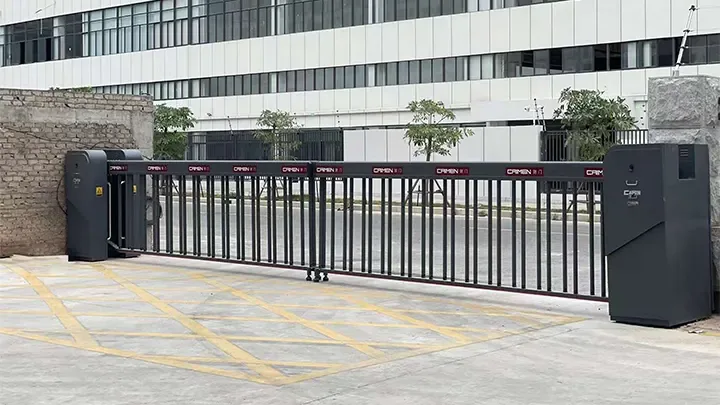
Gated community access control looks simple from the street. A gate, a guardhouse, maybe a camera on a pole. Then Monday morning arrives. Between 7:30 and 8:30 you've got two hundred residents trying to get out, a delivery van idling in the visitor lane, and a parent with a stroller stuck at the pedestrian door because her card is still upstairs on the kitchen counter. Below, we'll show how we'd plan that entrance: which CAIMEN products handle which flow, and what we need from you to quote it properly.
Four flows, one entrance
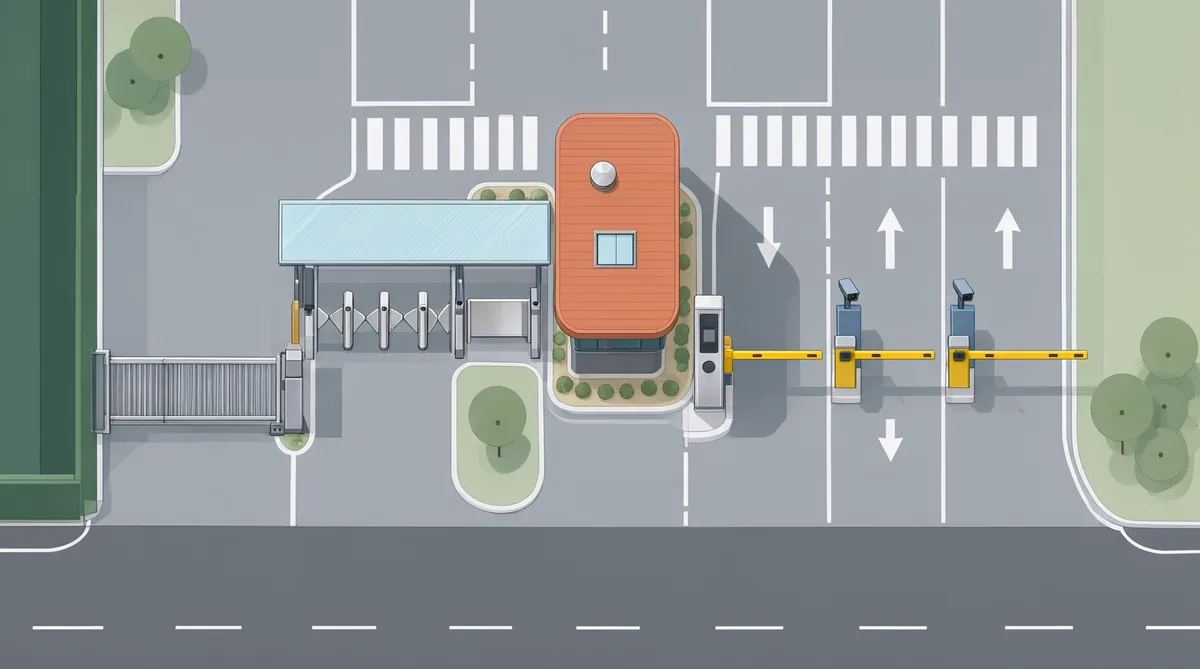
Most entrances go wrong for one reason. They treat every arrival alike. They aren't alike. A resident's car shouldn't have to stop at all, while a visitor needs to talk to someone first. Couriers? They need a short window that gets logged. People on foot want a gate that opens fast and shuts behind them, and it still has to let a wheelchair through.
That's four separate jobs at one entrance:
- Resident vehicles: the camera reads the plate and the barrier lifts. Nobody rolls a window down or digs for a card.
- Visitors and deliveries: give them their own lane, with a video intercom terminal and QR entry.
- Pedestrians: swing-wing lanes take face, card or QR credentials, and an accessible side gate sits beside them.
- Perimeter: a solid main gate. It stays open at peak hours and shuts the site at night.
ButterflyMX makes a good point in its piece on cutting tailgating at gated communities. Slow entry builds queues, and a queue tempts drivers to tuck in behind the car ahead. So speed at the resident lane isn't a luxury. It's security.
The recommended CAIMEN combination
Here's where we usually start. Your lane count and traffic set the quantities; the roles hardly change.
| Point on site | CAIMEN product | What it does there | Key figure |
|---|---|---|---|
| Resident in/out lanes | CP004 or CP006 plate recognition controller | Reads the plate, checks the list, triggers the barrier | CP004: plate read in about 0.1 s; both: recognition rate above 99.8% |
| Resident in/out lanes | KS01/KS02 high-speed barrier | Lifts for the approved car, drops behind it | 1.2 to 2.5 s per stroke; KS02 noise under 58 dB |
| Visitor lane | HJ001 or HJ002 video intercom terminal | One-click video call, dynamic QR entry for unregistered cars | 12-inch (HJ001) or 15-inch (HJ002) LCD |
| Pedestrian entrance | ST001 or ST002 swing-wing gate with face terminal | Credential check, infrared tracking, closes behind the user | ST001: 30 to 50 people per minute |
| Main perimeter | Cantilever sliding gate | Physical closure off-peak and at night | Clear span up to 18 m on a single leaf |
Resident lanes: plate recognition and a fast barrier
Residents are the easy win. Our license plate recognition controllers do most of the work here. The CP004 pairs a 5-megapixel camera with a listed recognition rate above 99.8%, day or night, and it'll identify a plate in roughly 0.1 second. Up to 50,000 records fit in its memory. It talks to your parking platform over 485 or TCP. A photosensitive switch turns on its 12 LED fill lights, and you'll be glad of that at 6 a.m. in January.
Behind the camera goes a KS01 or KS02 high-speed barrier from our barrier gate range. Depending on rod length, a stroke takes 1.2 to 2.5 seconds; the rod itself can reach 4,000 mm, cabinet included. If a resident misjudges the timing, the foam-covered rod with its anti-collision and reset mechanism absorbs minor knocks. Is the guardhouse under somebody's bedroom window? Then get the KS02. It's rated under 58 dB. The KS01 is under 65 dB.
Here's the honest part. A camera won't stop tailgating by itself. When two cars run bumper to bumper, what actually helps is a barrier that drops fast plus a loop or radar under the rod. On the DZ001-A barrier you can choose ground radar, a rubber strip or infrared, and there's a hand crank for lifting the rod if the power goes.
Visitors and deliveries without a queue
Give visitors their own lane. Mix them in with residents and a 10-second entry turns into a five-car backup.
We list the HJ001 terminal for exactly this kind of site: parking lots and gated residential areas. You get a 12-inch industrial LCD, a 2-megapixel camera and two-way video intercom in one column. One button press puts the visitor through to the guard. If nobody's on duty overnight, the call goes to a cloud-hosted operator instead. Cars with no registered plate scan a dynamic QR code to get in and out. Want a bigger screen? The HJ002 is the plate-recognition version, with a 15-inch display.
Say you manage a 300-home development and couriers show up all afternoon. A driver pulls in, presses the call button, and the guard or remote operator opens the barrier. Or the driver scans the QR code. Nobody walks out of the guardhouse. Passes that residents send out in advance are a different matter: those depend on your property's own software, connected through the integration point we agree during planning.
Pedestrian gates, and the accessibility catch
Foot traffic needs its own lanes too. Our pedestrian access gates come in two main formats:
- ST001: a 304 stainless steel case with acrylic swing wings and 8 pairs of infrared beams, moving 30 to 50 people per minute. It accepts fingerprint, face, QR or RFID. Lose power and the wings swing freely so people can evacuate.
- ST002: SUS304 shell, channels up to 830 mm wide, and more than 8 million rated open-close cycles at -35 to 75 °C. Its management side handles visitor pre-registration and temporary passes, which is how a guest arriving on foot gets in.
Prefer face entry? The 7-inch binocular face terminal stores 10,000 portraits and recognizes a face in 300 ms or less at 0.5 to 1.5 m. Blacklist, whitelist and temporary users are all supported. Mounting position is agreed in the drawing.
Now the catch. The ST001 spec calls it an indoor unit, so outdoors it belongs under a canopy or inside the guardhouse line. And never make a speed lane your only accessible route. According to the U.S. Access Board's guide to ADA chapter 4, turnstiles and manual revolving gates aren't accessible and can't be part of an accessible route; the same guide shows a 32-inch minimum clear width for gates on that route. Plan an automatic or push-button side gate right next to the lanes. Your local code consultant gets the final say.
The perimeter gate behind it all
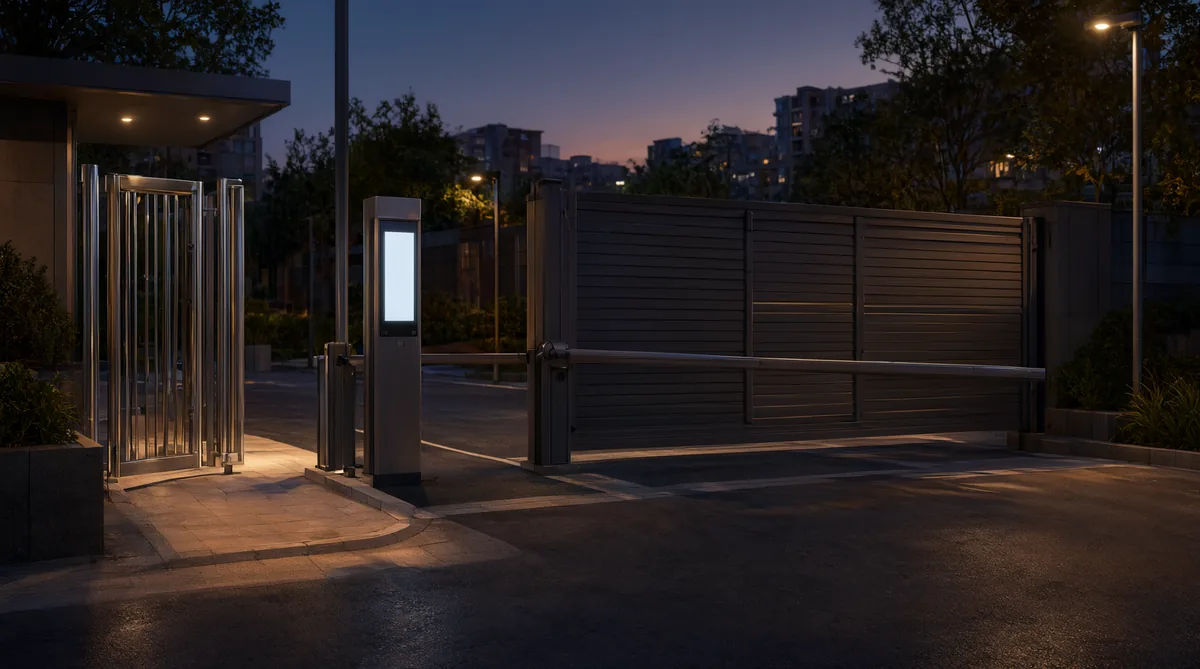
Barriers manage flow. They don't close a site. You need a real gate for that, and at most community entrances we'd pick a cantilever sliding gate, since nothing runs on the ground. No track to fill up with leaves, sand or snow.
The scheme in our documentation for integrated entrances is straightforward. During peak hours the cantilever gate stays open while plate recognition and the high-speed barrier carry the traffic. Off-peak and overnight it closes, and its infrared anti-climb function keeps watch. Our cantilever sliding gate spans up to 18 m clear on a single leaf. A 500 W variable-frequency motor moves it at 18 to 22 m/min, and through a standard dry-contact interface it'll take LPR, keypad, RFID, intercom, remote or app control. Aluminum gates come finished as standard in AkzoNobel Interpon D1000 powder, a coating that meets AAMA 2603. That rating belongs to the coating, not the whole gate; our coatings page explains what those powder tests do and don't cover.
Narrower entrance? A swing or villa sliding gate can do the same job. We've supplied an electric sliding gate for Guangzhou Fantasy Garden Mansion, among other domestic projects.
How to plan the entrance
- Count your peaks. How many cars leave in the busiest hour? That figure tells you how many resident lanes to build.
- Measure the stacking space. Between the street and the barrier, how many cars can wait without blocking the road? If it's one, the visitor lane has to be quick or sit further back.
- Decide who answers the intercom. A guard around the clock, a remote operator, or residents on an app. Your answer changes which terminal you choose.
- Map the pedestrian routes. Include the accessible side gate, and work out where the ST lanes get weather cover.
- Agree the integration point. Which system holds the resident list, your property software or the parking platform? Settle it before anyone pulls cable.
Lane logic gets a fuller treatment in our post on pairing license plate recognition with a barrier gate.
What to send us for a quote
It's a short list. Every item changes the drawing, though.
- A site plan or sketch showing entrance width, lane count and where the guardhouse sits
- Peak-hour estimates for vehicles and pedestrians
- Main gate opening width and height, plus the ground condition
- Power available at the entrance, and your climate range
- Preferred credentials (plate, card, face, QR, app) and any software we must connect to
- Finish color, and whether you want OEM branding
You'll get CAD drawings and renderings from us first. Production doesn't start until you approve them, and it typically takes 15 to 20 days after that. Email [email protected] or use the contact page.
Sources
- U.S. Access Board: Guide to the ADA Standards, Chapter 4 Entrances, Doors, and Gates
- ButterflyMX: How to Reduce Tailgating at Gated Communities
CAIMEN product figures come from our installation manuals and engineering documentation.