
Here's the odd thing about school gate access control: the load is wildly uneven. Buses, parent cars, bikes and several hundred kids on foot all hit your main entrance inside about twenty minutes in the morning. Then? Quiet, mostly, until the afternoon bell. Nights and weekends bring a third job entirely, which is keeping everyone out. One gate rarely handles all three well. Below we split the entrance into a vehicle side and a pedestrian side, match CAIMEN products to each, and list what we need from you to quote it.
The problem with one big gate
You know the setup. A wide steel gate gets propped open at 7:15 and, on a good day, closed again at 8:00. For those 45 minutes anybody can walk in. Eight o'clock flips the trouble around: a late student, a delivery driver and a visiting parent all end up at the same locked gate, and somebody from the front office has to go out and sort it.
Nothing broke there. The plan did.
Before you sketch a layout, spend an hour with two public frameworks. CISA's K-12 School Security Guide thinks in layers, so the property edge, the parking area and the building entrance each get a control of their own. The Partner Alliance for Safer Schools (PASS) guidelines use a similar layered model, with the property perimeter as the outermost physical layer. What does that mean for you? Your outer gate decides who reaches the grounds at all. Get it right and the building door stops carrying the whole load.
The recommended combination
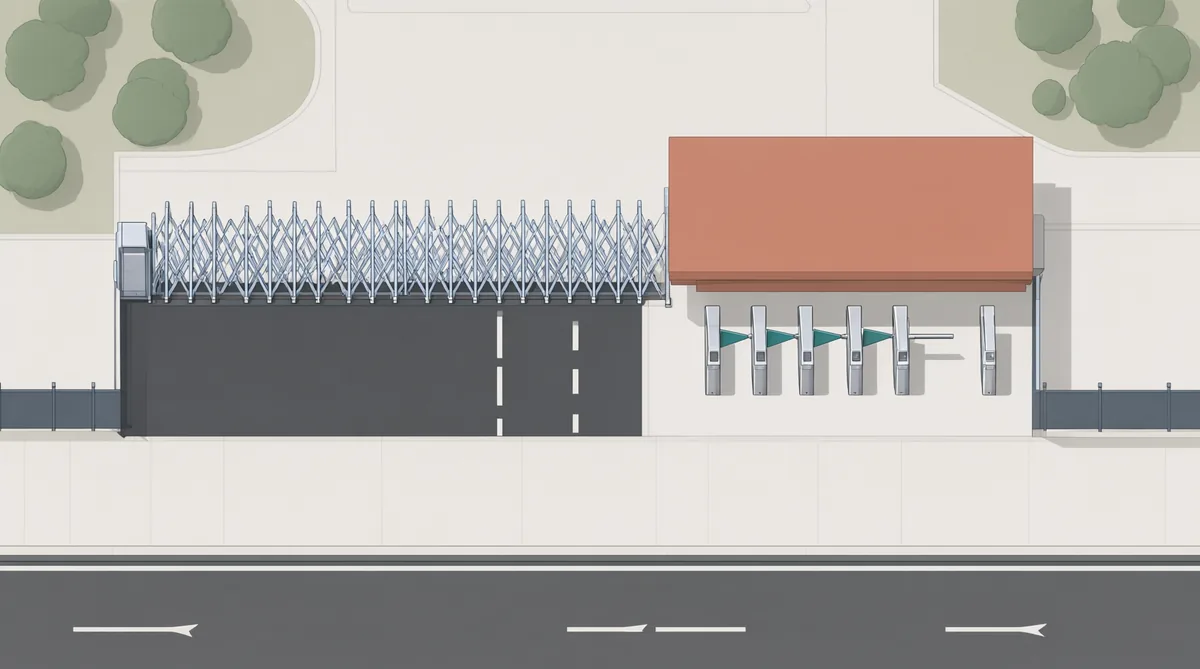
For most K-12 schools and small campuses, the main entrance needs two kinds of hardware. Just two. They stand side by side.
A telescopic sliding gate for the vehicle opening
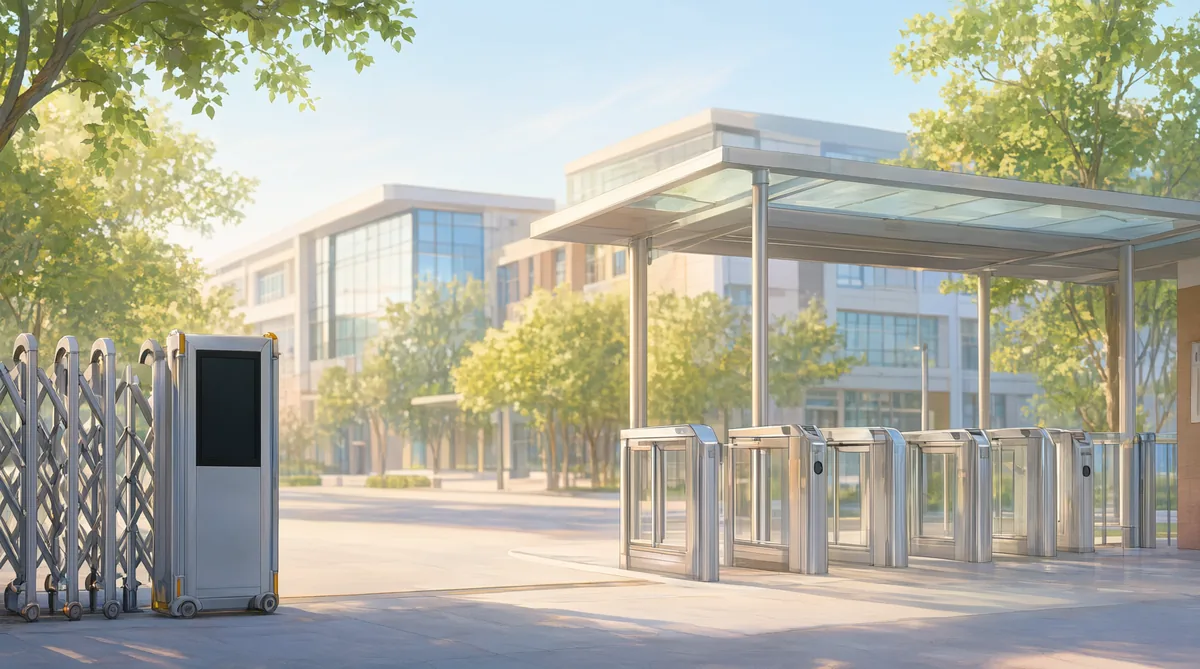
Wide opening, short stretch of fence beside it. That's the exact case our telescopic sliding gate was made for. Its 2 to 6 aluminum sections nest into one another as it opens, so you don't need a long run-back space next to the opening. Length goes up to 20 m. Height tops out at 1.6 m, and both can be customized. On most school frontages, that's a bus lane plus a car lane.
The build is fully assembled aluminum. No welding. You get a 4 mm frame panel and a fluorocarbon powder coat, and when gusts pick up, a 304 stainless steel anti-wind hook holds each section to the track. Motor thermal protection comes standard, along with soft drive, a manual clutch, an emergency stop, a scrolling display screen and a radio remote. About that display: as standard it can show status information at the entrance, but ask us whether custom messages are supported for your controller before you plan around them.
CAIMEN telescopic gates are installed at Tiananmen Square, the Beijing National Stadium (Bird's Nest) and the National Aquatics Center (Water Cube). Wide openings, heavy foot traffic. Sound familiar?
Pedestrian access gates for students and staff
Kids on foot don't belong in the vehicle opening. Line up a row of pedestrian access gates beside the main gate instead, and every student gets a lane plus a credential check on the way through. Two models cover most schools:
- ST001: A swing-wing lane rated at 30 to 50 people per minute. Wings are transparent acrylic; the case is 304 stainless steel. Card, QR code and face recognition modules are optional, and if the power goes out, the wings swing freely so people can get out.
- ST002: This one's closer to a full pedestrian access management setup. Each lane handles up to 30 people per minute through a channel up to 830 mm wide, and it's rated for more than 8 million open and close cycles. Visitor pre-registration and temporary passes? Supported. It also links to CCTV and fire safety systems.
A word of caution, though. The old ST001 spec sheet lists it as an indoor unit. If your lanes will stand in the open, they need a canopy or a gatehouse overhang. Don't skip it.
How to plan the entrance
Start with the clock. The catalog can wait. How many students walk in during your busiest ten minutes? Divide that by a realistic lane rate and you've got a lane count. Say you have 600 students, and most of them arrive between 7:40 and 7:55. At roughly 30 people a minute per lane, four lanes clear them in about five minutes. Two lanes take ten, and the line spills onto the sidewalk.
Vehicles next. Buses need the full width, no way around that. Parent cars often do better in a separate drop-off loop that stays ungated at peak and gets closed off afterward. Staff parking is a different story: a barrier gate with a card or plate reader usually works well there, and it means the main telescopic gate can stay shut once the last bus is gone.
Now the awkward edges of the day.
- Late arrivals: One staffed pedestrian lane with a visitor intercom. That's where they go. Keep them away from the vehicle gate.
- Deliveries: Fix a window. The office opens the telescopic gate by remote, and that's it.
- Evacuation: Check that the pedestrian lanes release on power loss. Your caretaker should also know how to work the vehicle gate's manual clutch, and a drill is a far better place to learn that than a real emergency.
- Accessibility: Plan for at least one wide lane, or a side gate, for wheelchairs and strollers. Clear widths and hardware rules for gates on an accessible route are covered in the U.S. Access Board guide to entrances, doors and gates.
Safety options worth adding at a school
Children push gates. They lean on them, too, and every so often one tries to ride one across the opening. So at a school, the optional safety kit on the telescopic gate counts for a lot more than it would at a factory.
| Option | What it does | Why it matters at a school |
|---|---|---|
| Anti-collision airbag | Soft edge on the leading section; contact triggers stop and rebound | A child at the gate edge gets a soft bump, not a hard hit |
| Anti-pinch protection | Mechanical bars on both sides stop the gate on contact | Fingers and bags near the folding sections |
| Infrared gantry | Three pairs of infrared sensors front and rear; lower beams for collision, upper beams for climbing | Detects someone climbing over after hours |
| Anti-climbing teeth | Optional anti-climbing deterrent | Makes the closed gate harder to scale |
| Voice prompt | Optional voice prompt function | An audible cue adds a second warning alongside lights |
Tight budget? Get the airbag and the infrared gantry first. We'd take those over a custom color any day.
A school we've supplied
Guangdong Sino-Canada Bairen School in China uses an electric sliding gate from CAIMEN. We'll stop there. The project record doesn't hold more numbers or details, and we won't make any up. Curious how a similar gate could fit your own frontage? Send drawings and we'll gladly compare.
Universities and bigger campuses rarely get by with one entrance type. A common mix runs like this: a wide telescopic gate on the main road, pedestrian lanes on the dorm side, a barrier at the service yard. Same planning logic each time.
What to send us for a quote
Some facts we just can't read off a photo. A good quote depends on them, so please send:
- Clear opening width and the gate height you want, for each vehicle entrance.
- A site plan. Even a phone sketch works if it shows the fence line, the side the gate should park on, and any slope.
- Your peak pedestrian numbers and the time window they arrive in.
- How students and staff will identify themselves (cards, QR codes, face recognition, or a mix).
- Where the pedestrian lanes will sit: indoors, under a canopy, or fully exposed.
- The safety options you'd like on the telescopic gate.
- Local power supply, plus any fire or evacuation rules your district applies.
Our CAD team draws the layout and renderings first. Nothing goes into production until you approve those drawings. From that approval, production typically takes 15 to 20 days. We take OEM and ODM orders as well, so a district or integrator can put its own spec on the job.
Email your details to [email protected] or use the contact page. Still torn between gate types? Our guide to telescopic gates for wide openings is a good next read.
Sources
- CISA: K-12 School Security Guide (3rd Edition) and School Security Assessment Tool
- Partner Alliance for Safer Schools: Safety and Security Guidelines for K-12 Schools
- U.S. Access Board: Guide to the ADA Standards, Chapter 4 Entrances, Doors, and Gates
CAIMEN product figures come from our installation manuals and engineering documentation.