A telescopic sliding gate fixes one specific headache: a wide entrance with hardly any wall beside it. Picture a 15 m factory entrance. There's a guardhouse 4 m off to the left and a loading ramp on the right. Where's a single sliding leaf supposed to go? Nowhere. Swing it open instead and it sweeps the apron right where your trucks queue. That's the job telescopic designs were made for.
We'll cover how the sections stack and which build details separate a gate that lasts from one that's dead by its second winter. We'll also be straight with you about when a cantilever gate or a swing gate suits your site better.
How a telescopic gate stores itself
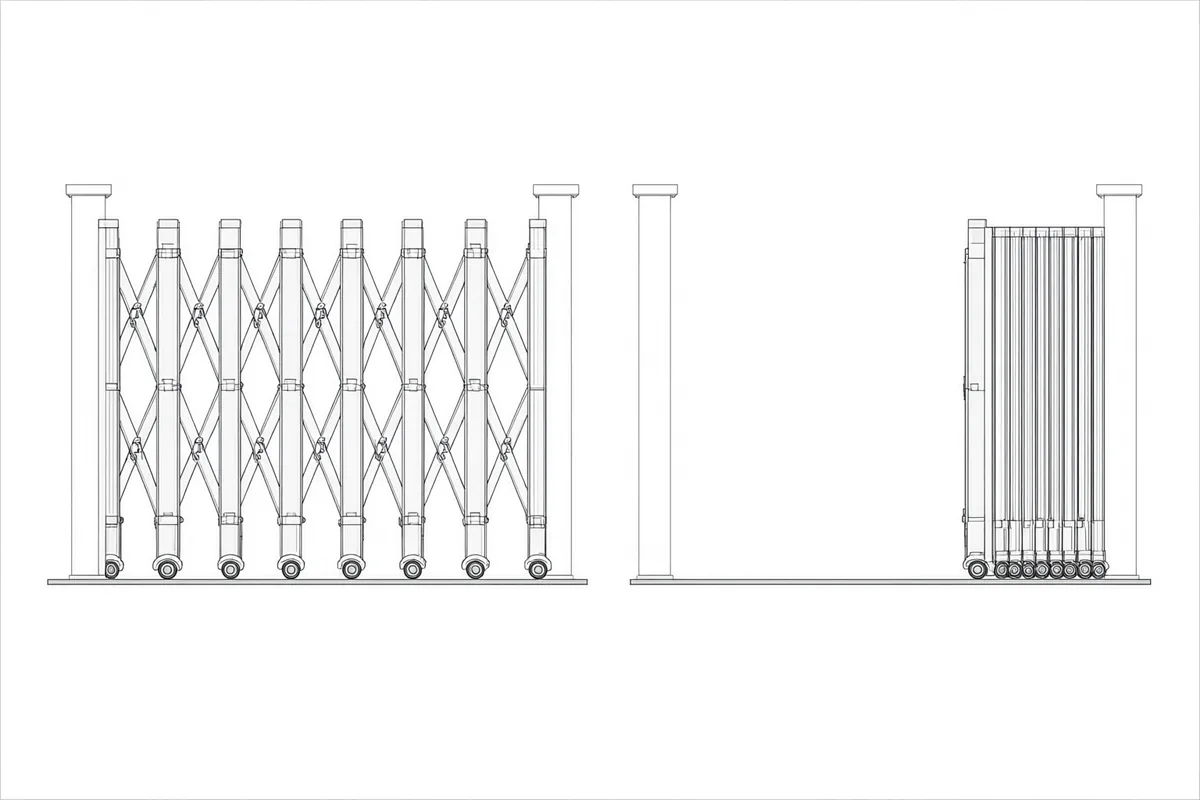
Start with an ordinary slider. It's one stiff leaf, so opening a 10 m gap takes at least 10 m of clear run next to it, and a cantilever design wants extra for its counterbalance tail. Telescopic gates dodge that math. They split the barrier into sections, and when the gate opens, those sections pull back toward one end and bunch up. The whole thing parks in a short stretch beside the post.
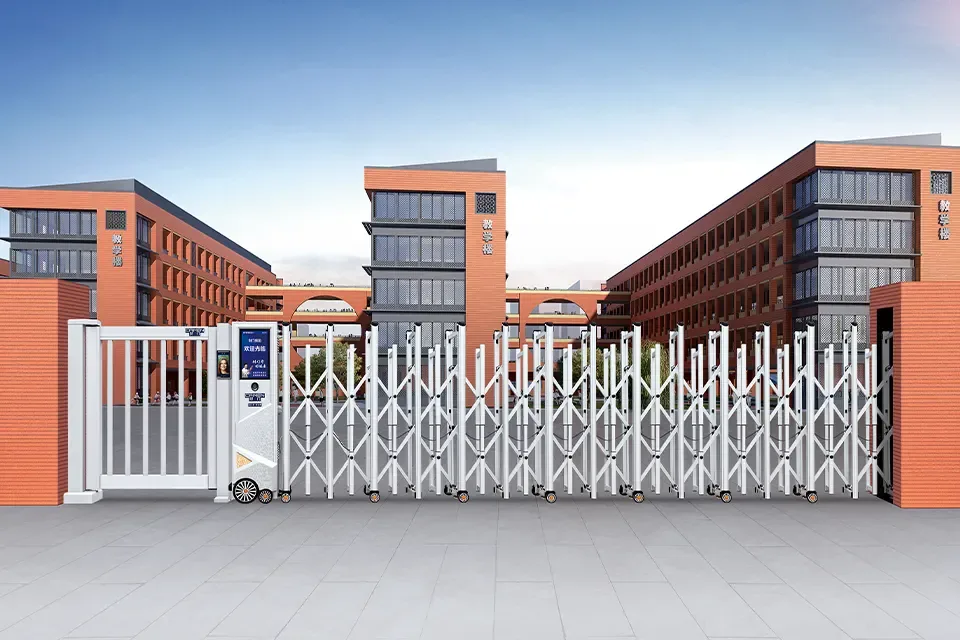
You'll run into two broad families. With overlapping leaves, two or three panels travel on parallel paths and the back one slides behind the front. That's how UK hardware supplier F.H. Brundle describes its telescopic kits: two leaves on a single track, needing far less clear space than a one-leaf slider. The other family shows up at big campuses, stadiums and plazas. It's the retractable sectional gate, where the sections draw back and collapse into a compact bundle at one end of the opening.
CAIMEN's telescopic gate uses 2 to 6 sections that retract toward one end. Total length runs up to 20 m. Standard height goes up to 1.6 m, and both are customizable. That's 65 ft of closure from one compact package.
Why section count matters
More sections buy you more reach. They also add joints, and every joint is somewhere alignment can wander. Two sections handle a modest driveway fine. Six will span a full plaza entrance. Six on a 5 m opening, though? Don't. You'd be paying for extra weight and moving parts that do nothing for you.
What to look for in the build
In a catalog photo, telescopic gates all look about the same. Give them five years and they won't. Here's what our engineering documentation specifies for the CAIMEN telescopic sliding gate, with the reason each item is on the list.
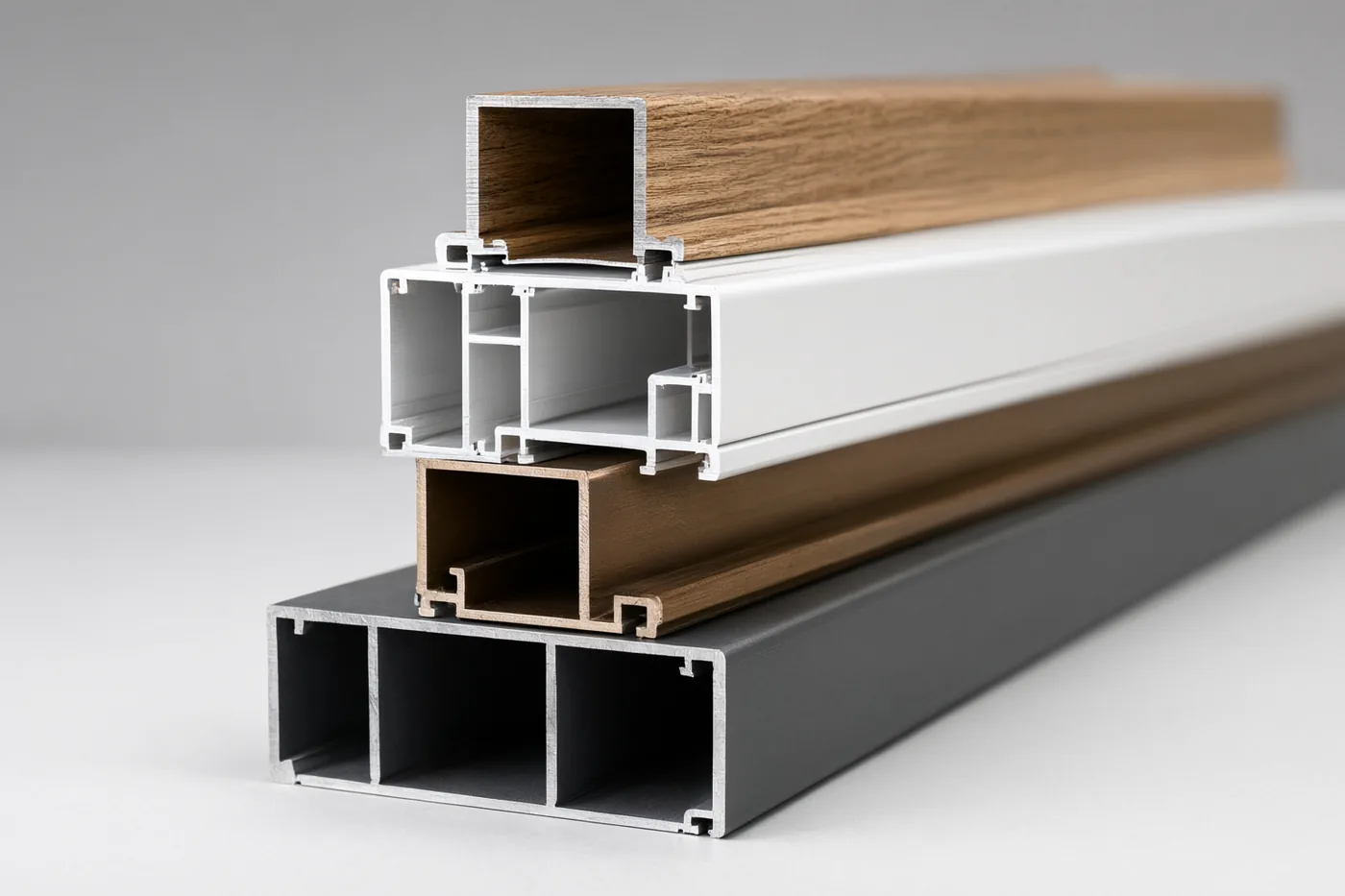
- Fully assembled aluminum structure, no welding. The frame's high-grade aluminum alloy, cast and precision-extruded, then bolted together. Skip the welds and you skip the heat-affected zones where corrosion likes to start. A bolted design is also generally easier to repair than a welded one.
- 4 mm frame panel. Thin panels flex when someone leans on them or a cart clips the leading edge. A thicker panel resists that flex.
- Integrated stainless steel cable guide bracket. Think about what the wiring goes through. Power and control cables ride along a gate that changes length on every cycle, and on older designs they flex until they snap. CAIMEN developed its fully assembled aluminum design specifically to address that cable-breakage problem, and the integrated stainless cable guide is a key part of that design.
- Upper linear guidance with stainless steel bearings. Sections track straight as they extend. No snaking.
- Dual-side, dual-wheel drive chassis and adaptive floating load-bearing rollers. Grip comes from both sides. The rollers adjust to small dips in the pavement, so the load stays spread out.
- 304 stainless steel anti-wind hooks. Catch a long gate in a gust and it acts like a sail. These hooks hold it against sideways push, whether it's parked or closed.
The finish is a fluorocarbon powder coating, standard color CM-01 Gray. You get motor thermal protection, soft drive, a manual clutch, an emergency stop, a scrolling display screen and a radio remote as standard. Want more? Options include an anti-collision airbag, a gantry, an infrared alarm, anti-pinch protection, anti-climbing teeth and voice prompts.
Our honest take: the cable guide and the anti-wind hooks matter more than paint color. If a gate looks sharp but loses its control cable in month eight, your crew ends up opening it by hand.
Telescopic vs. cantilever vs. swing
There's no single "best" gate type. It depends on your site. The table below uses CAIMEN product figures where we publish them and plain geometry where we don't.
| Factor | Telescopic sliding gate | Cantilever sliding gate | Swing gate |
|---|---|---|---|
| Side space when open | Short stack beside the post | About 1.5 times the opening in total gate length | None beside, but a full arc inside or outside |
| CAIMEN size range | Up to 20 m long, up to 1.6 m high, 2 to 6 sections | Up to 18 m clear span single leaf, 36 m bi-parting, up to 4.0 m high | Custom width, height and single or double leaf |
| Security height | Lower; crowd and vehicle control | High; perimeter security | Medium to high |
| Ground contact | Rollers travel on the pavement | No track across the driveway | Hinges only; slopes complicate the swing |
| Best fit | Wide entrances, tight side walls, plazas, campuses | Industrial perimeters, snow, sand, uneven ground | Residential drives with level approach |
Where does the cantilever number come from? Our installation manual's opening-to-length table, which says a 6,000 mm opening calls for a 9,000 mm gate. That extra half-length is the counterbalance tail. It's exactly why cantilevers struggle on cramped sites. Swing gates need no side space at all, but they do need a clear arc as wide as each leaf, and that hurts if cars park close or the drive climbs uphill from the gate.
Height is where telescopic gates give ground. At up to 1.6 m, they're built to direct people and traffic. A determined climber won't be stopped. Need a tall security barrier? Look at our cantilever sliding gate or the aluminum swing gate line instead.
Where CAIMEN telescopic gates are installed
You'll find CAIMEN telescopic gates at Tiananmen Square, the Beijing National Stadium (the Bird's Nest) and the National Aquatics Center (the Water Cube). Each site wanted something different from the gate.
- Tiananmen Square: automatic telescopic gates at strategic access points for crowd control. High durability and low noise came first.
- Bird's Nest: gates at multiple entrances and exits, custom-built for wide-span openings, with rapid-response automation and smart control.
- Water Cube: automatic telescopic gates handle vehicle and pedestrian entry in a high-humidity environment, so corrosion-resistant materials and intelligent safety sensors were part of the spec.
More installations are on our projects page.

Planning your opening
Get four things down before you ask for drawings. First, the clear opening width, measured at the ground rather than at the top of the posts. Then the length of straight wall or fence on the side where the gate will park. Walk the pavement too, since dips, drains and expansion joints all change how the rollers travel. Last, be clear on purpose. Is it crowd control, vehicle screening, or both?
Imagine a school entrance 12 m wide with just 2.5 m of wall on each side. A cantilever would need roughly 18 m of total gate length. It won't fit. A double swing gate? It'd block the pickup lane every time it opened. In most cases a telescopic gate in four or five sections can park in that wall space and leave the full 12 m clear, though the CAD drawing has to confirm the stack length first.
Don't skip safety. In the US, ASTM F2200 covers construction of automated vehicular gates, horizontal slide gates included, and the ASTM listing notes that automated systems are also expected to meet UL 325 for the operator. Ask your installer how they'll handle entrapment protection on site. If pedestrians share the path, specify the anti-pinch and infrared options. Rules vary by jurisdiction, so your local inspector gets the final word.
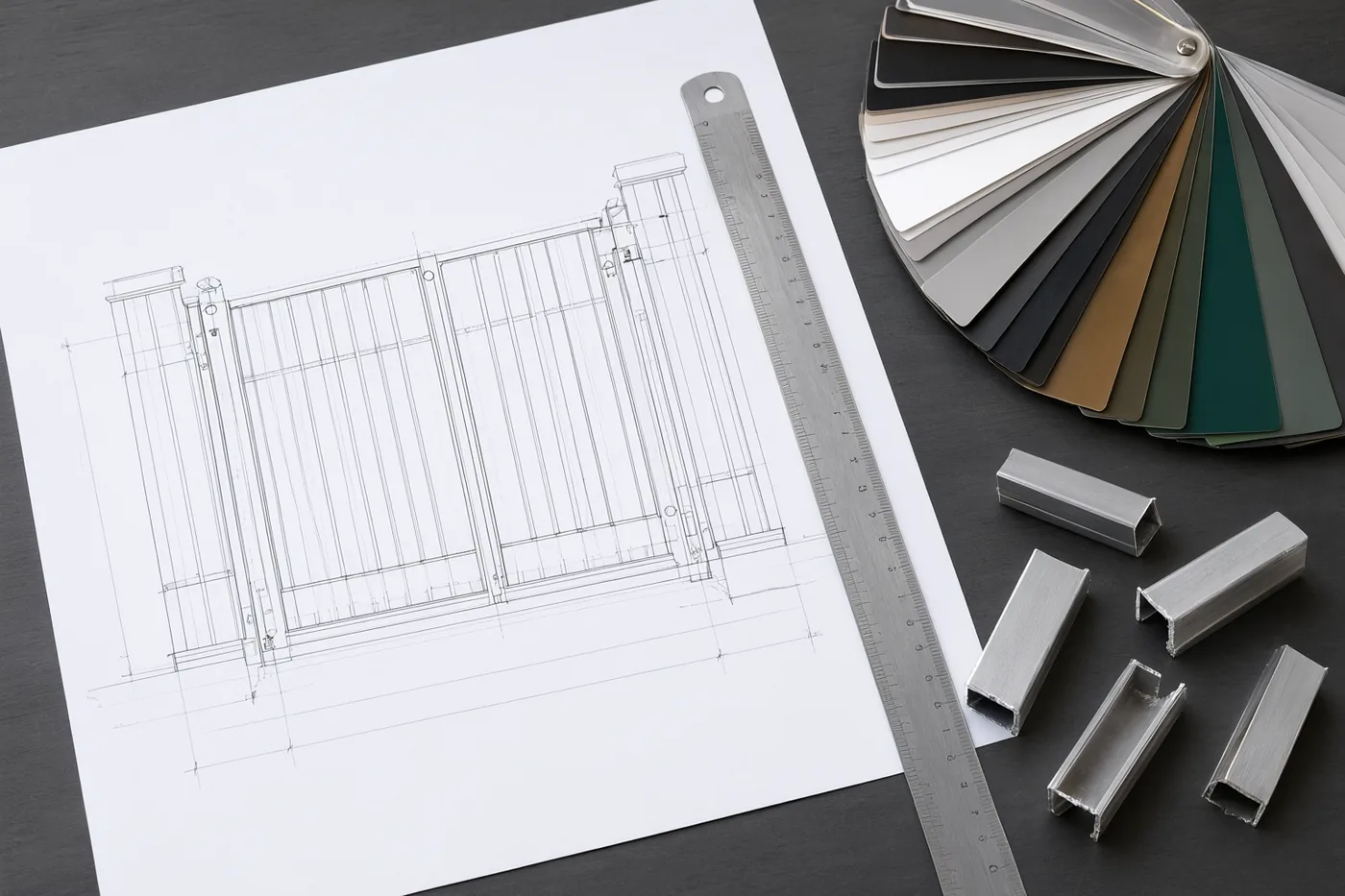
Every CAIMEN order gets CAD drawings and renderings, and nothing goes into production until you approve them. Production typically takes 15 to 20 days after drawing approval. Send your opening width, wall space and a few site photos to [email protected] or through our contact page, and we'll suggest a section count. Full specs live on the telescopic sliding gate product page.
Sources
- Telescopic Gate Kits - F.H. Brundle
- ASTM F2200-24 Standard Specification for Automated Vehicular Gate Construction
CAIMEN product figures come from our installation manuals and engineering documentation.