Plenty of aluminum gate spec sheets print "AAMA 2604" in bold type. Almost none say what it means. Here's AAMA 2603 vs 2604 in one breath: both grade the organic coating on the aluminum, and neither grades the gate. The gap between them is time, meaning how many years a finish keeps its color, gloss and chalk resistance on a test rack in South Florida.
Simple enough.
What you can honestly write in a submittal is where it gets fiddly.
What AAMA actually specifies
Start with the name. AAMA was the American Architectural Manufacturers Association; these days its standards carry an FGIA/AAMA label. The specs are voluntary, and they cover pigmented organic coatings on aluminum extrusions and panels.
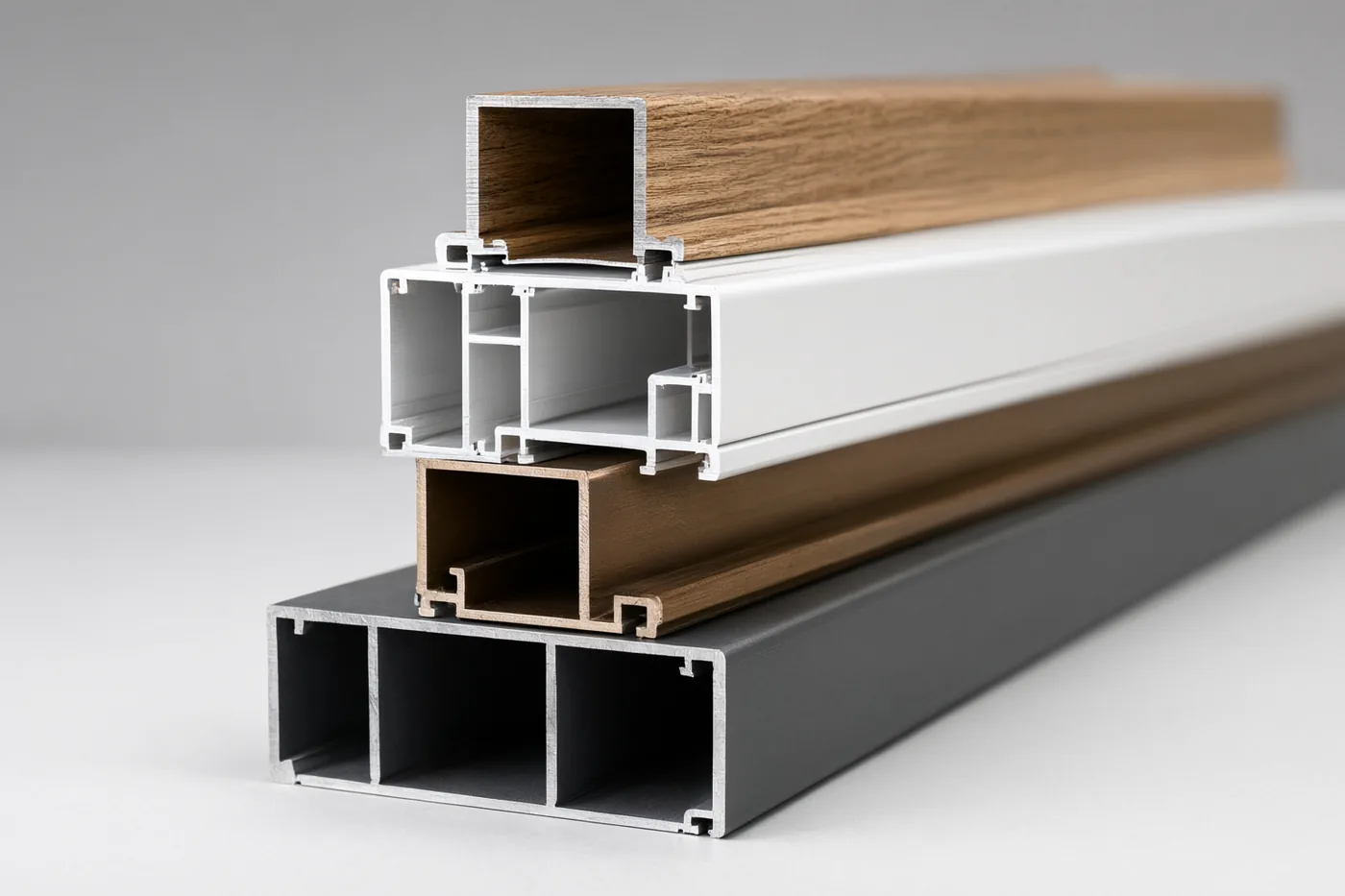
They were written for windows, storefronts, curtain wall. Gates borrowed them later, which makes sense once you think about it: a gate leaf is a long extrusion that never comes inside.
Products Finishing magazine lays them out as a ladder. 2603 sits at the bottom with fairly modest color and gloss retention. 2604 is stricter. 2605 is the top rung. Tnemec's explainer frames the same tiers as good, better and best, roughly one, five and ten years of color and chalk performance.
Here's the bit people skip. Every one of these tests runs on flat coated panels. No hinge. No welded corner. No motor housing bolted to a post.
AAMA 2603 vs 2604 side by side
We pulled the 2603 and 2604 rows from the AkzoNobel test reports behind CAIMEN's two powders. The 2605 row comes from public descriptions, and it's there only so you can see the top of the ladder.
| Spec | South Florida exposure | Color | Chalking | Gloss retention | Common application |
|---|---|---|---|---|---|
| AAMA 2603 | 1 year, 45 degrees facing south (optional in the spec; run in the D1000 report) | Only slight fading | Only slight chalking | Measured (ASTM D523) | Residential, light commercial |
| AAMA 2604 | 5 years, 45 degrees facing south, latitude 27 N | Max 5 Delta E (ASTM E805) | No. 8 (ASTM D4214, Method A) | Min 30% (ASTM D523) | Commercial, architectural |
| AAMA 2605 (reference only) | 10 years | Max 5 Delta E | No. 8 or better | Min 50% | Monumental, high-rise |
Compare 2604 with 2605. Color and chalk limits? Nearly identical. The clock is what moves: holding 5 Delta E for five years is hard, and for ten you need different chemistry.
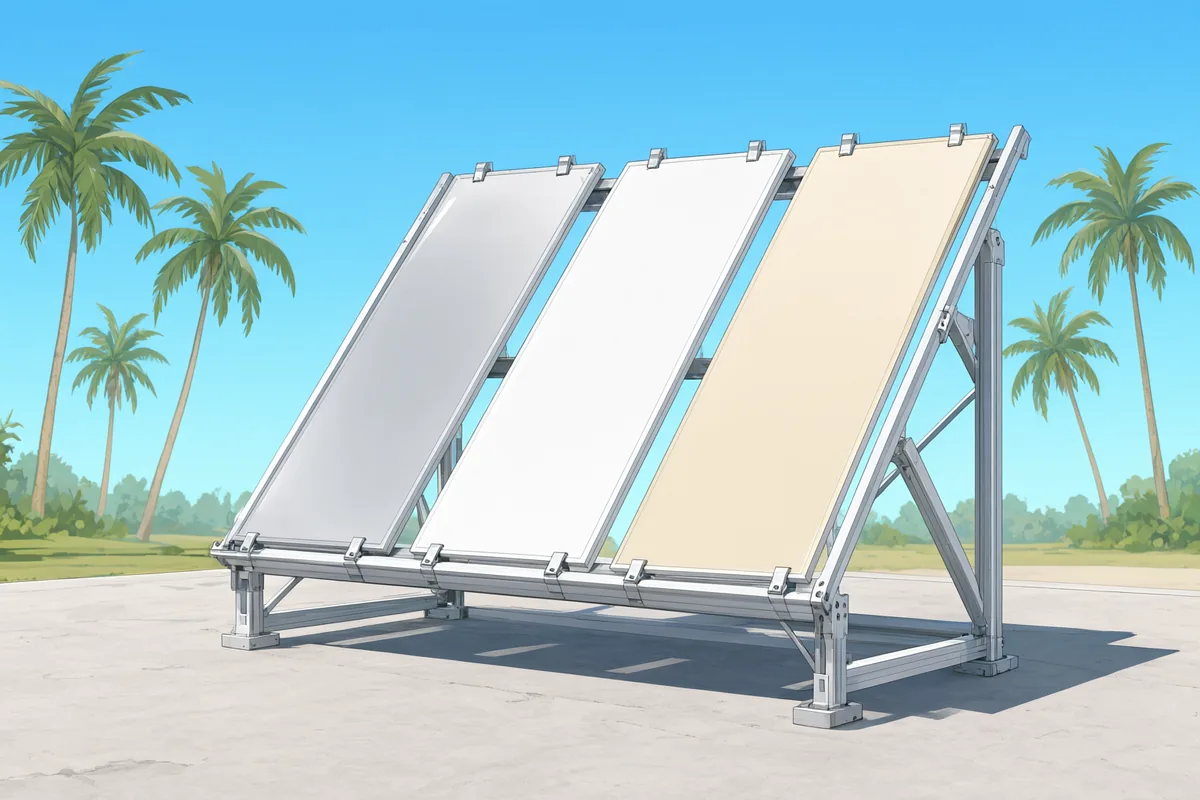
What the 2603 test on Interpon D1000 covered
CAIMEN's standard finish is AkzoNobel Interpon D1000, which meets AAMA 2603 and Qualicoat Class 1. AkzoNobel tested a representative D1000 sample to AAMA 2603-15 (Project 23843). It's a long report:
- Color, per ASTM E1331
- Gloss, per ASTM D523
- Dry film hardness (ASTM D3363) and film adhesion (ASTM D3359)
- Impact resistance, per ASTM D2794
- Chemical resistance
- Humidity (ASTM D2247) and salt spray (ASTM B117)
- South Florida exposure, per ASTM G7/G7M
The Florida panels sat at 45 degrees facing south for a year. To pass, they could show no checking, no crazing and no adhesion loss after taping, and only slight chalking and slight fading. Every exposed sample passed. Q-Lab ran the outdoor work.
So what does that buy you? Hardness, adhesion, impact, humidity and salt spray results, plus twelve months of real sun. For a villa driveway gate somewhere mild, that's usually plenty. Honestly, the install crew will have more say over that gate's lifespan than the coating tier will.
What the 2604 test on Interpon D2000 adds
Interpon D2000 is AkzoNobel's superdurable powder. It meets AAMA 2604 and Qualicoat Class 2, and CAIMEN sells it as an upgrade.
Years are the big difference. D2000 panels spent five of them in South Florida (latitude 27 N, 45 degrees facing south, under ASTM G7/G7M), with inspection data pulled at 60 months. Three limits had to hold:
- Color retention: no more than 5 Delta E change (ASTM E805)
- Chalking: rating No. 8 or better (ASTM D4214, Method A)
- Gloss retention: at least 30% of original gloss (ASTM D523)
ATLAS or Q-Lab handled the exposure. Five Florida summers is a brutal test. You pay for it.
Picture a dark bronze cantilever gate at a logistics yard in Arizona, leaf facing west, baking every afternoon. Dark colors show fade fast, so that's exactly where 2604 earns its money. A white gate behind a hedge in Oregon? Much less so.
Where AAMA 2605 fits, and why we don't claim it
You'll find AAMA 2605 on high-rise curtain wall and monumental work. PPG's summary of FGIA/AAMA 2605 lists ten years of South Florida exposure, color change of 5 Delta E or less, chalk rated 8 or better and at least 50% gloss retention. PVDF and FEVE chemistries tend to own that rung.
No CAIMEN gate finish claims 2605. D1000 (AAMA 2603) is standard; D2000 (AAMA 2604) is the option. If your project spec calls for 2605, tell us before drawings are approved. Not after.
Coating spec vs gate certification: the boundary that matters
This is where submittals go wrong. AAMA 2603 and 2604 describe a powder coating. They don't certify a finished gate.
Good wording: "Gate finished with AkzoNobel Interpon D2000, a powder coating tested to AAMA 2604." Bad wording: "AAMA 2604 certified gate."
Why the fuss? AkzoNobel owns those reports for its coating product, and the samples were flat panels in a lab program. Nobody put a gate from our factory on that rack.
And the spots that fail first on a real gate mostly sit outside any coating spec:
- Cut edges and drilled holes after coating
- Fasteners, wheels and rollers
- Spots scraped during shipping or install
- Areas where sprinklers or road salt keep the metal wet
Catch a leaf with a forklift tine, skip the touch-up, and 2604 powder won't save it. The spec grades paint. Workmanship keeps it on the metal.
On our end, CAIMEN cures its powder with a dual high-temperature process: two coats, two bakes. We also hold an AkzoNobel partnership certificate, number CN6002WD, valid for 2026. Those are facts about how the finish gets applied. They aren't a gate-level AAMA certification, and we won't pretend otherwise.
How to choose between D1000 and D2000
Three questions. How hard does the sun hit your site? How dark is the color? Who walks past this gate every day?
A light RAL color on a residential slide gate in a temperate zone will look fine on D1000 for a long time. Now change one thing. Go dark, turn the leaf south or west, move to a high-UV region, or put the gate at the front of a corporate campus, and you're leaning toward D2000. If the architect's spec already names AAMA 2604, there's nothing left to decide.
Coastal sites are their own headache. Construction Canada points out that AAMA 2605 doesn't address seacoast performance. Neither 2603 nor 2604 is written for it either. Salt air chews on edges, fasteners and damaged spots long before it bothers a sound film, so within sight of the ocean, watch your detailing and maintenance, not just the coating tier.
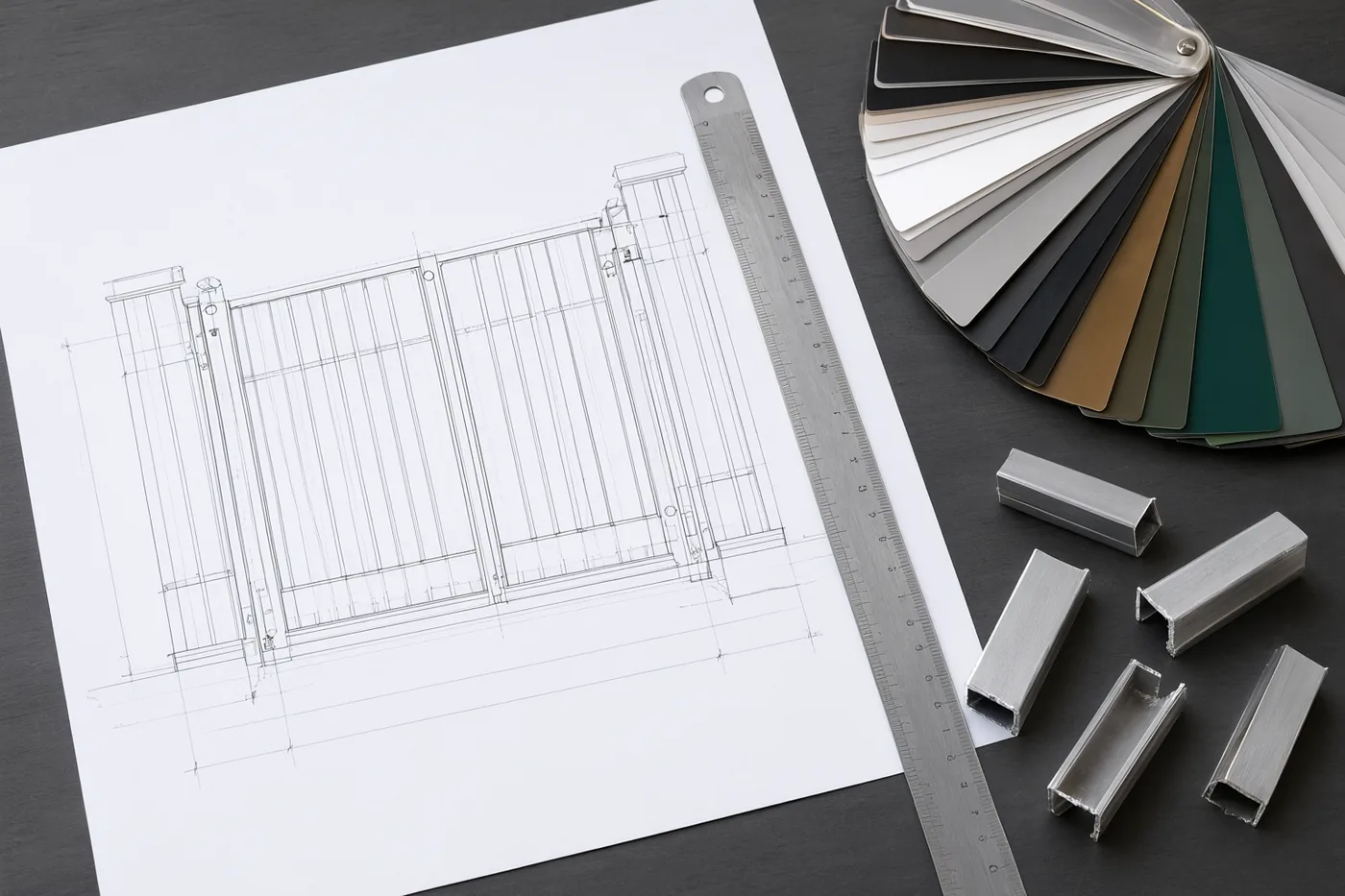
Color options and both coating systems live on our coatings page. Fully specified project? The custom aluminum gates process starts with CAD drawings and renderings, and nothing goes into production until you approve them. Lead time is typically 15 to 20 days after drawing approval. Our cantilever sliding gate ships with D1000 standard and D2000 as an upgrade.
Unsure about a spec section? Send it through the contact page or to [email protected], and we'll tell you plainly which lines we can meet.
Sources
- Understanding AAMA Specifications - Products Finishing
- AAMA Performance Standards Explained - Tnemec
- FGIA/AAMA 2605 - PPG Industrial Coatings
- Comparing liquid and powder coatings - Construction Canada
CAIMEN product figures come from our installation manuals and engineering documentation.