Your first custom gate from overseas will make you nervous. It should, a little. You're paying for something that doesn't exist yet, cut to fit an opening you might know only from four phone photos and a tape reading your site guy texted over. The factory? Several time zones away. What takes the edge off is knowing the sequence. So here's how a custom gate manufacturer like CAIMEN runs a job: what you send, when you send it, and which checks to run on any factory before money moves.
Written mostly for importers, distributors and integrators. Homeowners welcome.
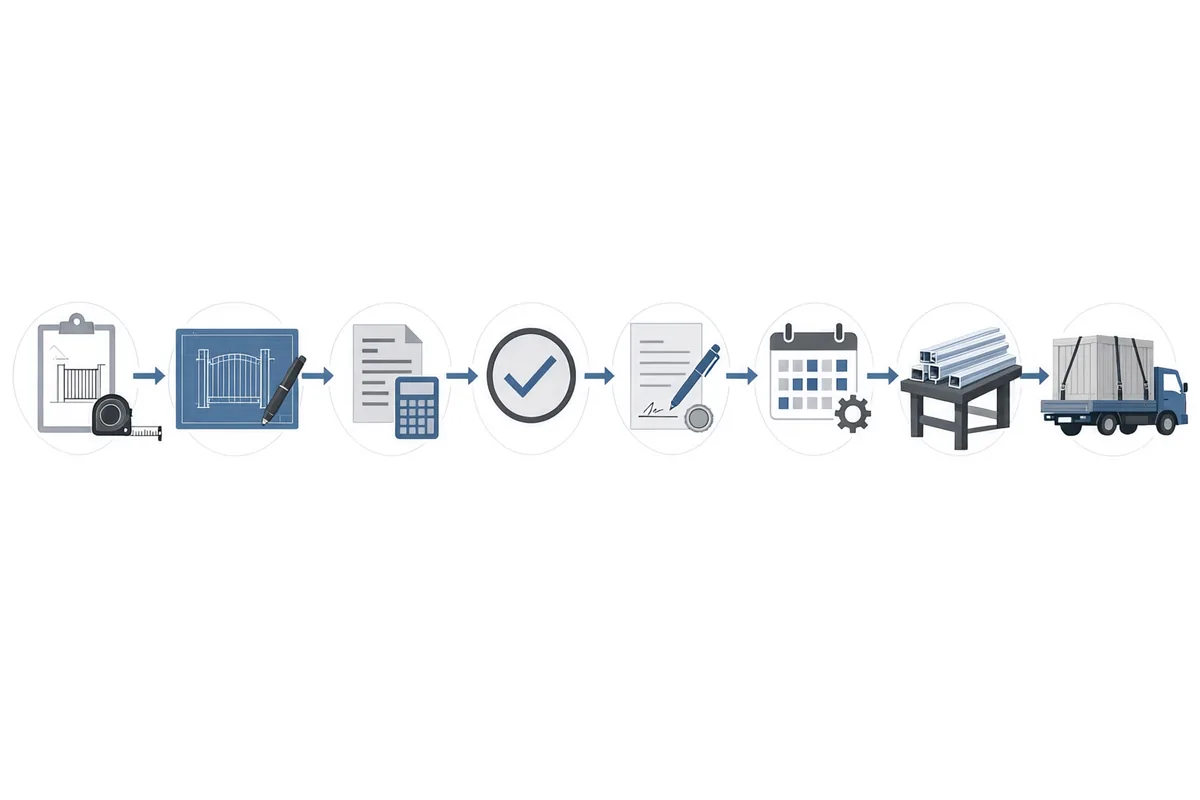
The eight stages, at a glance
Our engineering documentation splits every project into eight stages. Some take an afternoon. Production takes weeks. Your column is on the right.
| Stage | Factory side | Your side |
|---|---|---|
| 1. Requirement analysis | Engineers study your site data and how the gate gets used | Measurements, photos, notes on traffic |
| 2. Solution design | CAD drawings and renderings get drafted | Mark up whatever looks off |
| 3. Cost estimation | A quote on the concept you liked | Hold it up against your local budget |
| 4. Solution approval | Drawings are frozen | Written sign-off |
| 5. Order placement | Order confirmed | Shipping terms, destination port |
| 6. Production planning | Material and line time booked | Get the site and foundation ready |
| 7. Lean manufacturing | Fabrication, finishing, pre-assembly, testing | Book your install crew |
| 8. Logistics and delivery | Crating, dispatch | Customs, receiving |
Notice where price lands. Stage three. After design, not before, and that's deliberate. A quote on a gate nobody has drawn is mostly a guess with a currency sign on it.
What to send before the first drawing
Thin brief in, thin drawing out. Then a revision. Then another, and each loop costs you roughly a week of back-and-forth email.
So over-share.
- Clear opening width and target height. Post to post, with a tape. Not off a satellite view.
- Ground. Flat, sloped, crowned toward the street? A drainage channel cutting across the opening changes the bottom of the gate.
- Room beside the opening. A slider has to park somewhere when it's open. A swing leaf needs an arc that clears the owner's pickup.
- Photos from both sides, plus one from across the street. That's the view the neighbors get.
- Traffic. Say delivery vans roll through every ten minutes at shift change. Different motor, different leaf speed.
- Power and controls: supply voltage on site, and whether you want access control, plate recognition or just a remote.
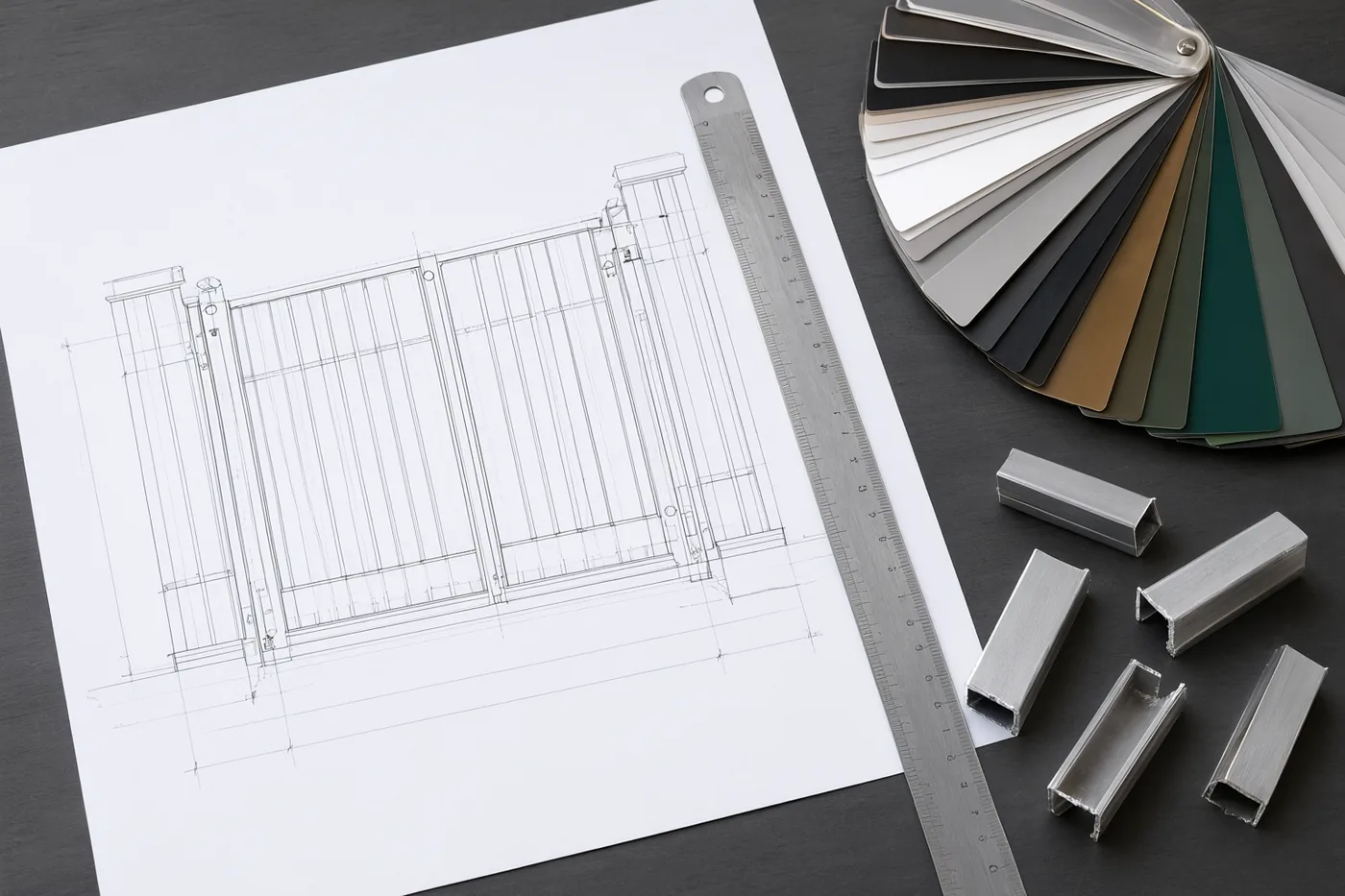
- Identity details. Brand colors, a logo panel, the infill pattern your architect won't let go of.
OEM buyers care most about that last bullet. CAIMEN takes OEM and ODM work, and its CAD team designs around site topography, ground conditions, special features and corporate identity. Putting your own label on it? Start with the OEM and ODM page.
Why CAD approval comes before cutting metal
One rule protects you more than the rest put together: nothing gets manufactured until the CAD drawings are approved. Not on a deposit. Not on a "yeah, looks fine" during a call.
Sounds like paperwork. It isn't.
An aluminum profile that came off the saw 40 mm short can't be stretched. Drill a hinge post on the wrong side and it's scrap. On screen, that same mistake is a two-minute edit; in a welded frame it's a reorder.
So catch it on paper. Print the drawings if you can and walk them out to the opening, because your memory of the site isn't the site. Doubt a number? Pull the tape again. Go slow on overall dimensions, the hinge or track side, where the motor and control box end up, and the gap between the bottom of the gate and the ground (that one bites on sloped drives). Sign after that. Not before.
One more day on approval is cheap. Rework takes weeks.
Haven't settled on a style yet? Browse the custom aluminum gates range first. "That one, but 600 mm taller" beats describing a gate from scratch, every time.
Production, crating and the paperwork that ships with it
Once drawings are approved, production typically runs 15 to 20 days. Factory days, that is. Ocean freight and customs come on top, and both move around with the port and the time of year. Don't book your install crew off the production number alone.
During that window the gate gets pre-assembled and its operation tested before it's packed. Worth the trouble? Yes. A track that binds is a quick fix on the factory floor, next to the spares and the tools. On your driveway it's a lost afternoon, with a paid crew leaning on the truck.
Crating
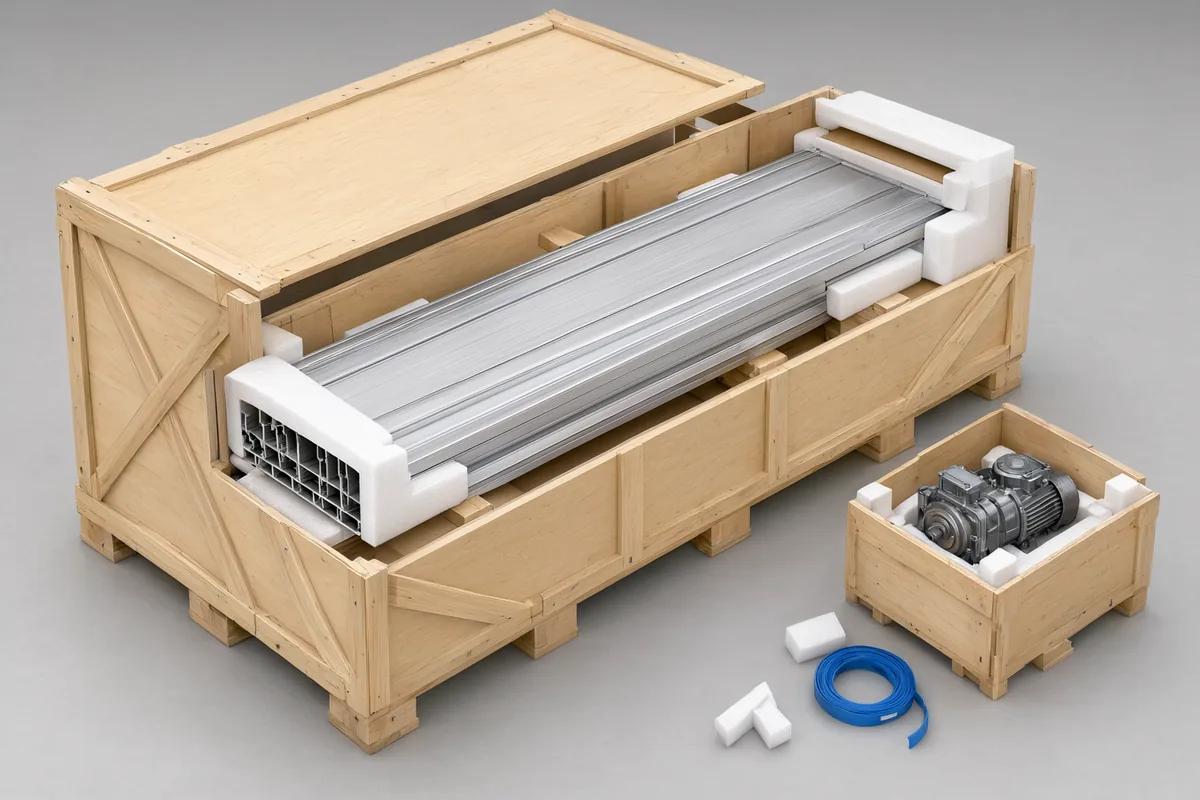
Ask early how a big gate will be crated. On one fully customized marina project in Saudi Arabia, every component went out in full wooden crates, and CAIMEN engineers followed up on site with installation guidance and commissioning support.
Wood raises a customs issue. Phytosanitary treatment. Many importing countries require wood packaging to meet the international ISPM 15 standard, and Canada's food inspection agency lays out what that involves: debarked wood, heat-treated so the core holds at least 56 °C for 30 continuous minutes, then marked by a registered facility. No mark, and your crate may sit at the port. Ask to see the stamp.
What should be in the box
Installation drawings and technical support should travel with the gate. Get a packing list too, before dispatch, matching crate numbers to parts. Skip it and your crew pries open six crates looking for one bracket.
How to check a factory before you commit
Every supplier's homepage says "quality." Ignore it. Ask for management-system certificates and product certifications, and get actual copies, not a strip of logos in the footer.
| Ask for | What it tells you | Check on the copy |
|---|---|---|
| ISO 9001 | A quality management system exists | Company name, scope, issuing body, expiry |
| ISO 14001 | Environmental management system | Name, scope, dates |
| ISO 45001 | Occupational health and safety system | Name, scope, dates |
| CE | Conformity marking for the EU market | Which product it names |
| FCC | US radio-frequency compliance for electronics | Which device or model it covers |
CAIMEN holds ISO 9001, ISO 14001 and ISO 45001, plus CE and FCC. Use the table as a request list for any factory you're vetting. It's not a scorecard.
Here's the bit buyers miss. ISO 9001 certifies how a company runs, not a particular product. TÜV SÜD, one of the big certification bodies, describes it as a certifiable quality management system kept up through regular surveillance audits. Translation: the factory has a process for catching defects. That's not the same as any one gate being type-tested.
Then go a layer down. Do raw materials show up with test reports? At CAIMEN, each batch of aluminum profile arrives with a third-party test report. Whose powder is on the gate, and what was it tested to? CAIMEN uses AkzoNobel powder coatings, and the published weathering tests apply to the powder coating itself, not the finished gate. More on the coatings page.
One way a partnership starts
Small, usually. A system integrator from Iraq saw CAIMEN gate samples at a security exhibition in Dubai and placed a sample order on the spot.
That single sample became a long-term channel partnership. Today the integrator runs projects in its home market, and CAIMEN backs each one with solutions, technical support and quotations.
No trick to it. They saw the build in person, tried one order, and scaled up. New supplier making you uneasy? Copy them. One gate, one site, the full process end to end. Then send the pipeline.
Before you send the first email
Measurements. Photos from both sides. Notes on the ground, the power, any branding asks. Decide who signs off the drawings, and give that person a real afternoon for it, not five minutes between calls.
Send the lot through the contact page or to [email protected]. A complete first message gets you to a usable drawing faster than anything else will.
Sources
- Attention exporters: Requirements for wood packaging material in outbound shipments from Canada (Canadian Food Inspection Agency)
- ISO 9001 Certification Mark (TÜV SÜD)
CAIMEN product figures come from our installation manuals and engineering documentation.