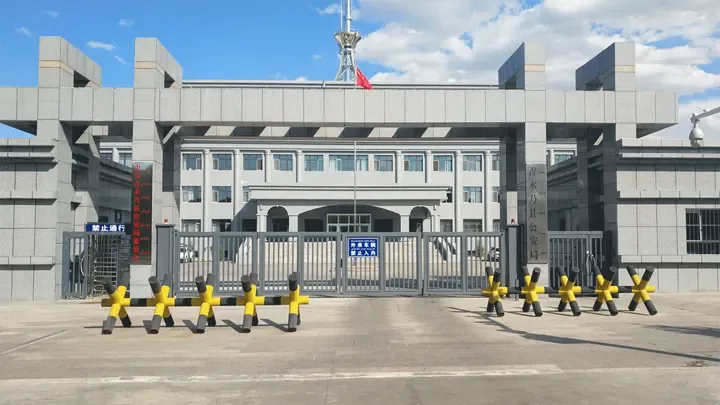
A government security gate has two jobs, and they fight each other. Stop the vehicle that shouldn't be there. Wave through the one that should, with no drama: the fire engine, the minister's car, the van carrying court files. Then there's the awkward bit. Public buildings are public, so people walk up, queue at the door and now and then hold a protest on the steps. Below you'll find how we'd layer road blockers, bollards and gates at a site like that, where each CAIMEN product earns its place, and what we need from you to quote.
Three lines, not one gate
City hall, courthouse, tax office, police headquarters. We see the same layout at nearly all of them, and it's worth stealing.
- The outer line sets the boundary and soaks up crowds. Usually that's a wide gate left open during office hours, then closed at night or for an event.
- The vehicle checkpoint is where a car really gets stopped, looked at and let go. Put your road blocker here, or a row of bollards behind a barrier arm.
- The pedestrian line keeps staff, visitors and the public apart. If the power dies, it must open so people can get out.
Why not one big gate? It'd crawl at 8:30 in the morning, confuse every visitor and fail all at once. Splitting things up also lets you harden one zone more than another. Your loading dock round the back doesn't need what the front plaza needs.
The CAIMEN combination for public buildings
Here's where our product lines slot in. Every figure below is taken from our published product sheets, and you'll find the full tables on each product page.
| Zone | Product | Published figures that matter here |
|---|---|---|
| Vehicle checkpoint (main) | Road blocker CM-3M-20H500 / 20H600 | 500 or 600 mm interception height, electro-hydraulic, PLC control, rise and fall 1 to 4 s, IP68, AC380V 50Hz at 3.75 kW, manual raise and lower on power failure |
| Vehicle checkpoint (lanes, plazas) | Automatic bollard | 219 mm 304 stainless body, 600 mm rise, rising 4 s or less, lowering 2 s or less, IP68, EPS backup and one-button emergency drop |
| Outer line | Telescopic sliding gate | Up to 20 m long and 1.6 m high (customizable), 4 mm frame panels, fully assembled modular aluminum with no welding, 304 stainless anti-wind hook |
| Daily traffic control | High-speed barrier gate with plate recognition | KS01/KS02 open or close in 1.2 to 2.5 s depending on arm length |
| Pedestrian line (lobby or under the entrance canopy) | Swing-wing lanes ST001 | Indoor unit; face, fingerprint, QR or RFID; wings swing free on power loss for evacuation |
One note on that last row. The ST001 is an indoor unit, so set it inside the lobby or under a canopy, not out on an open forecourt.
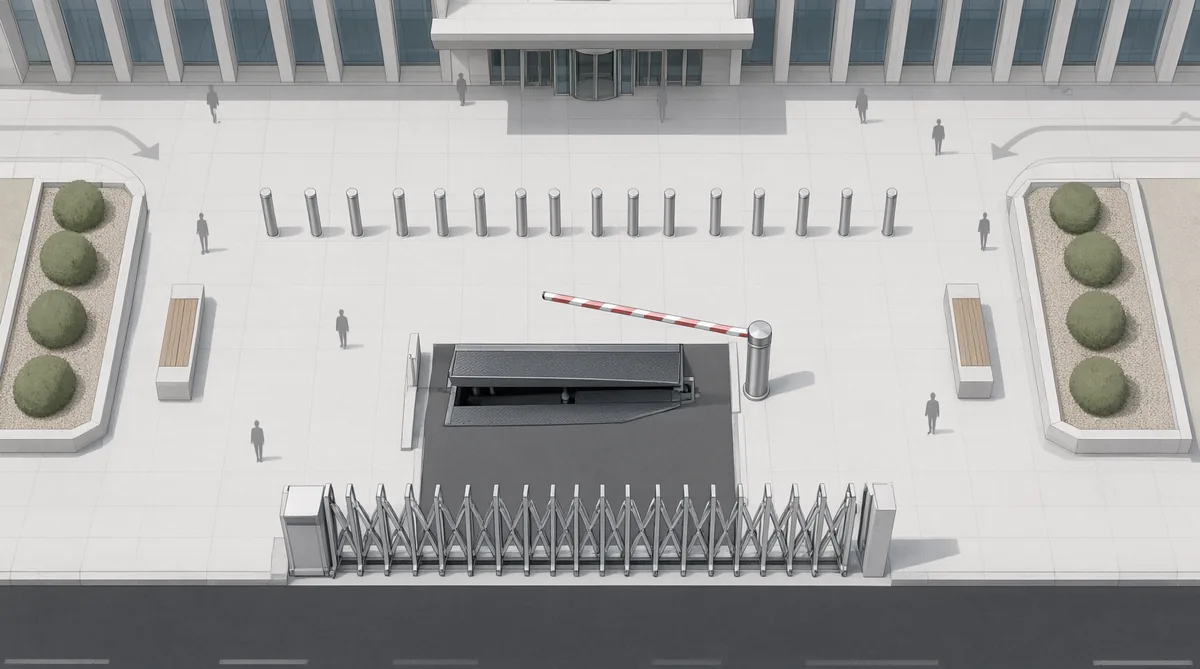
At a typical front entrance you'd see a barrier arm with a road blocker a few meters behind it. Routine traffic belongs to the arm and the plate camera, and staff cars come and go all day without anybody touching a button. The blocker? It lies flat for authorized vehicles. It comes up when a guard says so, or when the system is told to hold everything. Because it links to traffic lights, infrared, ground loops and plate recognition, the light can go red before the plate rises.
Bollards fit spots where a big steel wedge would look wrong. Think of a pedestrian plaza outside a museum, or the edge of a ceremonial drive. Lowered, they sit flush and people stroll over them. Raised, each one is 600 mm of stainless steel. How far apart to set them is your security consultant's call.
A straight word on crash ratings
Buyers skip this part sometimes. Don't. It matters more than the finish color.
US anti-ram barriers are rated under ASTM F2656. The ASIS article "Crash Ratings 101" lays it out: an M-rating means a medium-duty truck of up to 15,000 lb hit the barrier at 30, 40 or 50 mph, and the P-rating records how far the truck got past it, with P1 being 1 m or less. That same article warns that unrated products sold as "high security" can give you a false sense of protection. CISA's Guide to Active Vehicle Barrier Specification and Selection points the same way: match the barrier model to the site's access needs, not the other way round.
So here's what our numbers do and don't mean. Container trucks under 220 tons can pass over the road blocker, according to its sheet. The bollard sheet says it carries truck passage up to 100 tons without deforming. Those are load figures. They tell you the unit survives heavy traffic rolling across it, and that's all. They aren't crash ratings, and you won't find an ASTM F2656 rating on our published sheets. Does your security plan or your agency's rulebook call for an M-rated barrier? Put it in your first email. We'd much rather say up front what documentation we can and can't supply than have it surface at inspection.
Plenty of public sites don't need a crash-rated product at every opening. A council office car park, a library service yard, a school district headquarters: control and deterrence are the job there. Let your security consultant decide that. Not a brochure.
Where CAIMEN gates already stand
You'll find our telescopic gates at Tiananmen Square, the Beijing National Stadium (the Bird's Nest) and the National Aquatics Center (the Water Cube). At Tiananmen they guard access points used for crowd control. The Bird's Nest needed custom builds for its wide-span entrances and exits. Humidity drove the Water Cube brief, which asked for corrosion-resistant materials and safety sensors. Our projects page shows all three.
One more case deserves a mention, since it's a working government site and not a landmark. The Xinjiang Traffic Police Headquarters runs cantilever gates with an integrated pedestrian door, access control and emergency escape.
CAIMEN is also a registered brand on China's central government procurement network. That doesn't replace your own approval process. On certifications, the company holds ISO 9001, ISO 14001 and ISO 45001 for its management systems, and products carry CE and FCC marks.
How to plan the site
Say you're planning a regional courthouse. It has one main vehicle entrance, a 14 m wide front plaza and a rear yard for prisoner transport. Here's roughly how we'd work through it with you.
1. Map who arrives, and when
Staff cars. Visitors. Deliveries, emergency vehicles, secure transport. Write down the peak numbers for each. If 120 cars pull in between 8:00 and 9:00, you need a fast arm and plate reading at the checkpoint, not a gate that takes twenty seconds to cycle.
2. Decide what fails open and what fails closed
Pedestrian lanes should release when power goes. Vehicle barriers are a different story. With EPS backup and a one-button emergency drop, the bollard won't leave fire crews stranded outside. If the supply cuts out, guards can raise and lower the road blocker by hand. Agree the procedure with your local fire authority before you order anything.
3. Check the civil works early
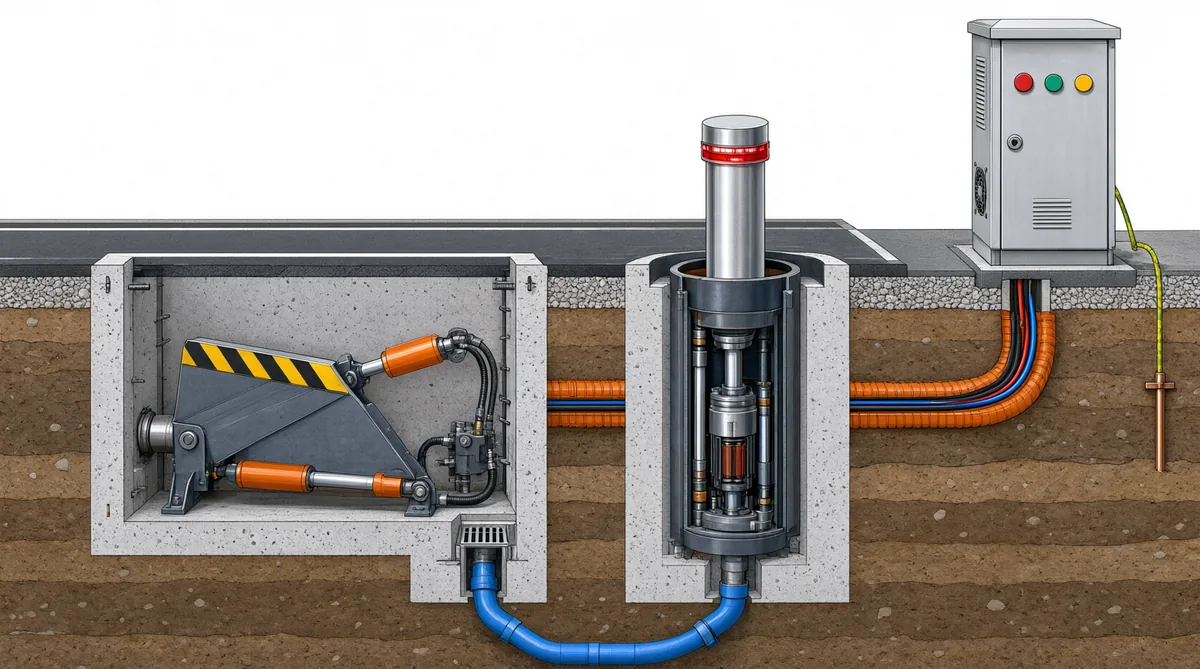
Projects slip here more than anywhere. The road blocker's pit follows the model's box size: 2,000 to 6,000 mm long and 760 mm deep, with a width of 1,000 mm for the CM-3M-20H500 or 1,100 mm for the 20H600. It also wants a three-phase 380 V supply. Each bollard drops into an embedded cylinder 800 mm deep and 335 mm across. Both need drainage, since standing water in a pit is a frequent cause of trouble for hydraulic units. Plan the control cable ducting while you're at it.
4. Match the outer gate to the opening
A telescopic gate folds its sections into a short stack, which is why it suits wide frontages with little side room. Got an opening over 20 m? A cantilever gate in a bi-parting pair covers up to 36 m of clear span, and it can go up to 4.0 m high if you want a taller, solid-looking line. Mixed sites often use both.
What to send us for a quote
Keep the first email short. Send us:
- A site plan, or a phone photo of a sketch, with each opening's clear width marked.
- Which zones need stopping power and which just need control.
- Any standard or rating your agency names, ASTM F2656 included.
- Power available at each point (380 V three-phase or 220 V).
- Systems the barriers have to talk to: plate recognition, fire alarm, an existing access control platform.
- Climate notes, like coastal salt, heavy snow or flooding.
You'll get CAD drawings and renderings back for each entrance. Nothing goes into production until you approve them, and from that point it typically takes 15 to 20 days. Shipping and installation guidance come after. Need a custom finish to match a historic facade? Our coatings page explains the powder systems we use.
Email the details to [email protected] or use the contact page. Start with your hardest opening. That's usually where the whole design gets decided.
Sources
- ASIS Security Management: Crash Ratings 101
- CISA: Guide to Active Vehicle Barrier Specification and Selection Resources
CAIMEN product figures come from our installation manuals and engineering documentation.