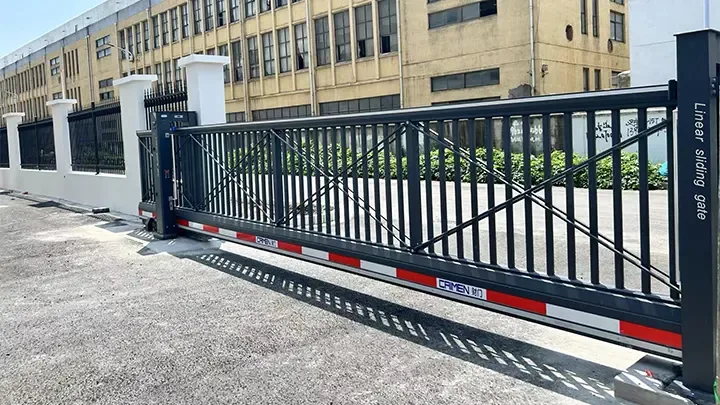
Your factory gate is asked to do two things that fight each other. At 6:45 a.m. it has to take in a wave of cars, vans and the day's first trucks before the queue spills onto the public road. At 2 a.m.? It needs to be a wall. Most sites lean on one gate for both, and that's the root of the headaches. Below is the factory gate solution we'd put in front of a manufacturing plant, warehouse or logistics hub: a trackless cantilever gate as the physical barrier, with plate recognition and high-speed barriers carrying the daily flow.
Why one gate rarely works for a busy plant
Think about the main entrance of a mid-size plant on a Monday. Forklifts cut across the apron. A trailer swings wide. Some delivery driver stops right at the line to ask where dock 4 is. Now put a single big motorized gate in charge of all that, and every car sits there while it opens, then waits again while it closes. Ten or 15 meters of travel isn't instant, however quick the leaf is. Multiply that by every vehicle.
So someone props it open all day. At that point it's decoration.
There's a mechanical problem too. Ordinary sliding gates ride on a ground track, and a track laid across a truck entrance gets punished: loaded axles, grit, ice, now and then a pallet fork dragged over it. Bend it or pack it with debris and you've got a jammed gate. Our cantilever design takes that rail out of the driveway completely. That's why it anchors the setup below.
The recommended combination
Split the job. That's really the whole idea. The heavy cantilever gate becomes your perimeter, while barrier arms and plate cameras deal with the constant back-and-forth, and people on foot get their own turnstile lane well away from the trucks.
| Component | Role at the entrance | Key figures (from our product data) |
|---|---|---|
| Cantilever sliding gate | The perimeter barrier, closing the full opening after hours | Clear span up to 18 m single leaf or 36 m bi-parting; height up to 4.0 m; 500 W VFD drive at 18 to 22 m/min |
| High-speed barrier gate (KS01/KS02) | Controls each lane through the working day | 1.2 to 2.5 s to open or close, depending on rod length; rod up to 4,000 mm including cabinet |
| License plate recognition (CP004) | Reads staff and fleet plates you've registered and logs each pass | Dual-color LED display, readable beyond 30 m; 10M/100M Ethernet with lightning protection |
| Pedestrian access gate (ST001) | Gives workers on foot a lane of their own | Face, fingerprint, QR or RFID; wings swing free if power fails, for evacuation |
Need a hard stop that physically halts a vehicle? Add a road blocker inside the line. It's optional, and useful where a site must physically stop a vehicle.
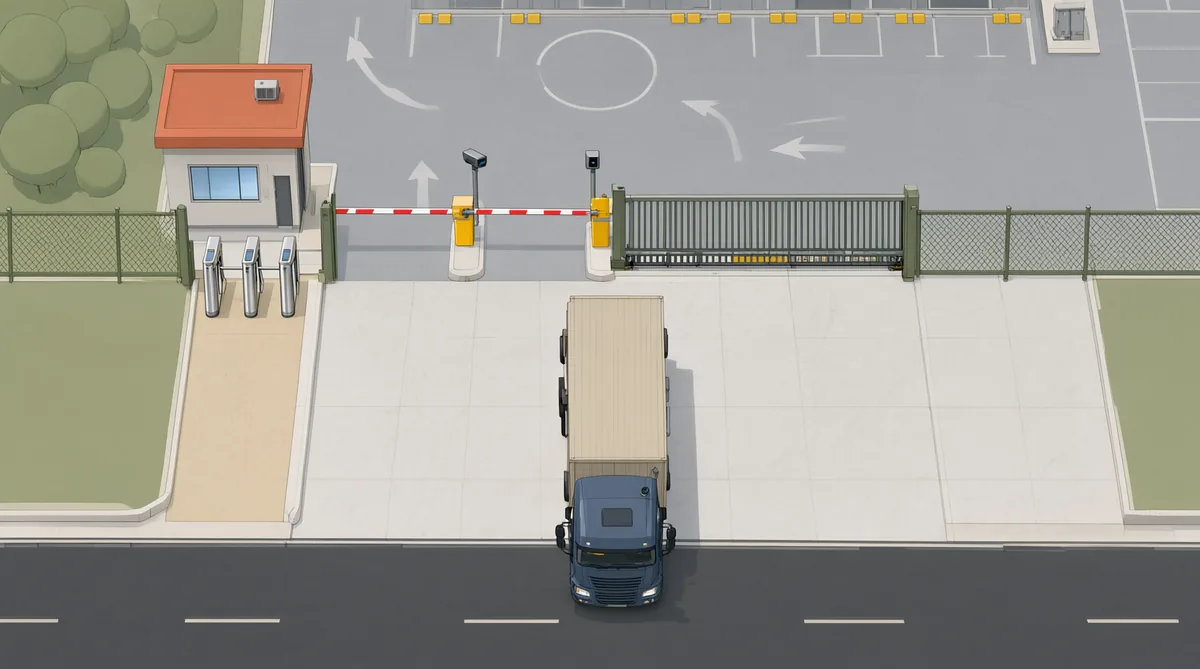
How the entrance runs through a 24-hour day
Shift peaks
At shift change the cantilever gate just stays parked open. Traffic goes through the barrier lanes. A plate camera reads each incoming car, matches it against your registered list, and up goes the arm in a second or two. Nobody's waving a badge out the window, and your guard isn't leaning into every cab. According to the U.S. Department of Homeland Security's SAVER TechNote on license plate recognition, any LPR system has three parts (an imaging subsystem, recognition software and an output to the user), and working day and night in all weather is the hardest part for the imaging subsystem, meaning the camera and lighting. Be honest about that limit. Light the read point well, and lay the lane out so vehicles come in straight and slow.
Trucks don't behave like cars. Say thirty inbound trailers show up between 7 and 9 a.m. A lot of them belong to outside carriers, and their plates won't be in your system. Route them to a lane of their own, or behind a guard-released barrier, so one unknown plate can't freeze the staff lane. For more on lane logic, see our article on pairing LPR with a barrier gate.
Off-peak and night
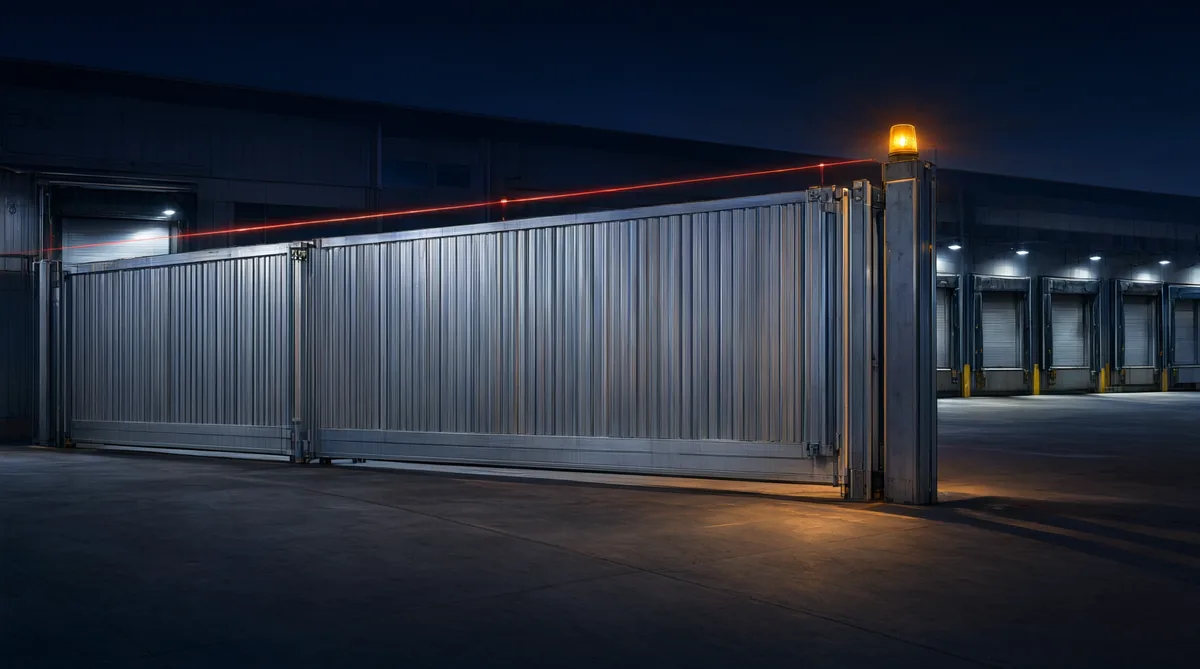
When the shift has settled in, close the cantilever gate across the whole opening. It's the barrier now. The arms behind it turn into a second layer. On top of the leaf, an infrared anti-climb sensor keeps watch, and anyone trying to go over sets off a 10-second alarm. With the motor stopped, the gate holds with a self-locking force of at least 300 N, so you can't just shove it open by hand.
Late deliveries? They'll happen. The gate takes a dry contact relay signal, which means a guardhouse button, an intercom or the LPR controller can open it for a known vehicle and shut it again behind.
Planning the truck apron and the gate line
Most entrance problems get decided right here, not in the catalog. Sort out the geometry before you worry about color.
Setback from the road
You don't want a waiting truck parked across a traffic lane. Plenty of local codes set a minimum stacking distance. Sedona's Land Development Code is one example: it asks for 40 feet of stacking where a drive meets a street, and wants an approved stacking lane anywhere an entry gate or guard house controls traffic. Forty feet fits a car. A tractor-trailer is far longer than 40 feet. If trucks will wait at your barrier, push the control point back far enough that at least one full rig clears the road, and check what your own jurisdiction asks for.
Runback space for the leaf
Here's the part people forget. A cantilever leaf is longer than the opening it closes, since the counterbalance section has to sit behind the gate line. Our installation manual's sizing table puts total gate length at 1.5 times the opening in every row, so a 6,000 mm opening needs a 9,000 mm leaf and 7,500 mm needs 11,250 mm. Check that your fence line has that much room, with no parked trailers or dock traffic in the way.
Really wide entrances can go bi-parting. In one anonymized airport perimeter project, a 22 m opening was split into two 11 m leaves (16.5 m long each), and the bi-parting setup cut the required opening time in half. A logistics yard where two trucks need to pass side by side works on the same logic.
Foundation, power and data
Every support point sits on an 800 x 800 x 800 mm foundation, concrete grade C20 or better. Keep the cabinet, gate frame and hanger wheels level to within plus or minus 10 mm. You'll want a dedicated circuit on a 6 A breaker, properly grounded. And lay the data conduit in the same trench. The LPR camera, the barrier controller and the gate all have to talk to each other, and digging twice costs more than dropping in a spare pipe now.
Built for trucks and weather
The leaf hangs on a 12-wheel carriage with top, bottom and side rollers. Its bottom beam is 6005-T6 aluminum with up to 7.0 mm wall thickness. Pull rods? Heavy-duty cast steel, on a stainless steel bracket. Because the parts bolt together, there's less welding on site, and a worn part can be swapped out. It's rated to operate from -35 to +70 C.
The safety devices are built in, not bolted on later: an infrared beam covering up to 20 m that stops and reverses the leaf, a pressure-sensitive leading edge, mechanical anti-pinch protection, an overhead sensor with warning light, emergency stop and manual release. If a forklift crosses your apron forty times a shift, you'll be glad of every one.
On finish, the standard powder coating is AkzoNobel Interpon D1000, which meets AAMA 2603 and Qualicoat Class 1. Coastal ports and chemical plants should look at Interpon D2000 instead, a superdurable powder meeting AAMA 2604 and Qualicoat Class 2. Keep in mind those ratings describe the coating, not the complete gate. Details are on the coatings page.
What to send us for a quote
Your first email can be short. Send us these and we'll start on drawings:
- Clear opening width, plus the leaf height you're after
- A site sketch or photo showing the road, the apron and the fence line on both sides
- Daily traffic: rough counts of cars, trucks and people, and when shifts change
- How you'll identify vehicles (LPR, RFID, guard release, intercom), and whether there's an access system already in place
- Climate notes like coast, snow, sand or high wind
- Power at the gate (110 V or 220 V AC, 50 or 60 Hz)
We do CAD drawings and renderings first. Production only starts once you've approved them, and it typically takes 15 to 20 days after drawing approval. Email [email protected] or use the contact page.
Sources
- License Plate Recognition, SAVER TechNote, U.S. Department of Homeland Security Science and Technology Directorate
- Sedona Land Development Code 5.5.G, Loading and Stacking Areas
CAIMEN product figures come from our installation manuals and engineering documentation.